Aigronne Valley Wildlife pages

Showing posts with label November. Show all posts

Wednesday, 23 November 2011

A Delicate Parasol

As we were driving up the hill from Chambon we did the usual screech-to-a-halt and reverse as Tim spotted something in the ditch beside the road. As well as some tennis-ball sized orange puffballs, there was a solitary parasol mushroom [Lepiota procera] Coulemelle, Lépiote élevée, with the most delicate lacy top and a coating of minute droplets glittering in the late afternoon sun. I was allowed to look after this precious jewel on the way home, and observed how stiff the stem was (not edible, unlike the parasol itself). The liquid on the top of the parasol was not, as Tim had first thought, dew, but some form of slightly sticky mucilage - not a slug trail, although there was slight damage to the top, probably caused by a slug.

Parasol Mushroom [PK74339]
Like a Christmas tree ornament
After photographing the mushroom, it was broken up and deposited in various locations on our property, along with some blewits and a shaggy ink-cap, in the hope that they may establish themselves to form the basis of further photographs, not to mention meals.

Saturday, 19 November 2011

Get Orfff moy Laand!

Tim was peacefully looking out of the window this morning when he saw two crows escorting a large sparrowhawk off the premises. A very large sparrowhawk. Bigger, in fact, than the crows. In fact, it was a goshawk (accipiter gentilis) [autour des palombes]. We thought we'd seen one before, but weren't sure, although they are believed to nest in our commune. The English name derives from the anglo-saxon for "goosehawk", and the French name means "around the woodpigeons" - both these names give an impression of the size of prey the goshawk is capable of taking out. For this reason, the goshawk was popular in falconry. Here's a lovely picture from the BBC's Nature website.


In Britain, the goshawk was blamed for the death of game birds and, between the gamekeepers and the egg-collectors, became extinct in the 19th century. Escaped falconry birds and others from continental Europe have re-established a small population. They are still persecuted by the small number of egg-collecting criminal monsters.
In rural France, goshawks were treated as vermin (nuisibles) for their taste for creatures that humans like to eat, both wild and tame - "espèces gibier ou de basse cour". They have been protected since 1976, and their numbers are believed to be rising. This area has a great deal of their preferred open woodland habitat, and they have an excellent choice of prey - squirrels, rabbits, hares, voles, pheasants, partridges, pigeons, crows, starlings, thrushes.... but they are by no means common and it's lovely to know they are around. I love the expression la basse cour for the small domestic creatures such as fowl and rabbits that were so often to be the domain of the farmer's wife and children.

Thursday, 10 November 2011

I bet you can't do this!

Every autumn, flocks of lapwings (vanellus vanellus) vanneau huppé appear on the newly-ploughed fields up and down the Aigronne, taking flight at the least alarm and keeping in contact with each other by means of their "peewit" calls. At the moment, there are usually a few starlings (sturnus vulgaris) étourneau sansonnet with them, and later in the year, golden plover.

Just a small part of a larger flock.
There are bigger flocks in France than in the UK because farming methods over here are more favourable to their breeding cycle. Just north of Amiens we stopped and took pictures of a flock of over a thousand... it was an amazing sight!

Just part of the huge flock seen in October 2005... too big to capture in one shot!!

They are always worth a few pictures on a sunny day, with their white underparts flashing as they swirl aroud over their chosen feeding spot. This year Tim's photos caught one bird in the middle of a barrel roll, flying upside down....

Hey guys! Can you do this?

Wednesday, 1 December 2010

I'm a Timberjack and I'm OK

Yesterday our skyline changed forever. 

The difference between the top picture and the ones beneath is a gap of four days!
And three hours work.... [The middle picture shows a tree falling.]


The wood crowning the hillside opposite the house is basically a plantation of Corsican pines (tall, very dark green) with a fringe of Scots pine (not quite so tall, lighter green with reddish bark), a little clump of Stone pine at one end and an under-storey of scrubby deciduous trees - hornbeam, cherry, oak, ash, etc). It's rich wildlife habitat, providing nest sites for many birds, including buzzard, and shelter for mammals such as fox, rabbit and roe deer. The wood has been hunted very thoroughly every weekend and jour ferié since the season began, including this Sunday when thick wet snow fell all day and all the hunters had to wear fluorescent orange jackets. Today we found out why.

Just before lunch, a tree muncher appeared, labelled 'Timberjack'. This is a big engine with balloon tyres and an arm that simultaneously supports, cuts, and trims a full-sized tree. Along with it came a white van. This being France, the two drivers went off for lunch. After lunch, they returned with a log grabber. This is another big engine with balloon tyres, but this time the arm is fitted with a grab almost as flexible as the tip of an elephant's trunk, and it sits on a very large log-basket indeed. Both the engines set off up the snow-covered field, carving two deep ruts into the winter wheat.

Abbateuse.... with the original skyline behind.


Soon trees were falling. The engines cut down and moved aside a couple of the deciduous trees, making themselves enough space to be able to get through to the real target - the Corsican pines. These began to fall one by one, the first machine trimming them to lengths of two or three metres and gradually disappearing into the wood. Daylight began to appear between the remaining trunks as the dark green puffs of the pinetops tumbled out of the sky. Then the second machine returned to stack the logs by the roadside. The driver used the grab first to lift the timber into neat stacks, separating obvious firewood from half-decent logs and - the longest ones - good timber. Logs whirled around and plonked into place like so many pencils. If a log wasn't quite in place, the driver folded the grab into a fist and tapped the end of it delicately until he was happy with it.

As the afternoon wore on, we spotted another party of cranes heading south. The log grabber returned again and again with more timber. As night fell the drivers simply turned on floodlights and carried on working. Today half the pines have gone - all those to the right of the ditch except the clump of stone pines. The men and their machines departed well before nightfall, job done, leaving a neat stack of logs on the roadside.

Forty years ago this task would have taken a dozen men a week, and undoubtedly a few injuries along the way. Now it takes two men and some technology supplied by the forestry arm of John Deere. The log muncher is an abbateuse and the grabber is a porteur forestier. A second hand abbateuse might set you back 80,000 euros.

There will be more about this method of forestry in a later post on Art en Saule

Wednesday, 24 November 2010

House of flying Baggers

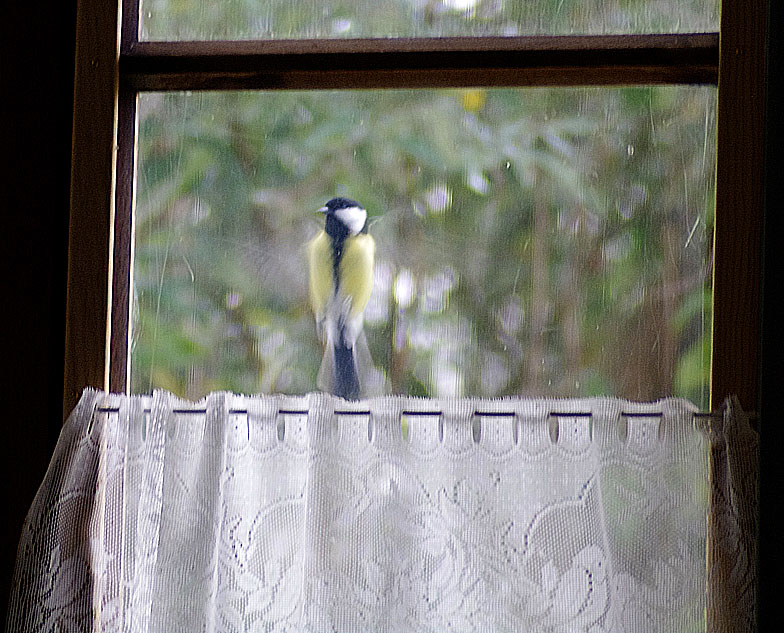
Outside our bedroom window hangs a bird feeder stocked with sunflower seeds, along with a fat-ball on a wire. These are visited by a constant stream of blue tits and great tits which have become adept at extracting the seeds. Yesterday the supply ran dangerously low, so we received a deputation - three great tits and a blue tit perched on the window bars, the largest of the great tits rapping on the glass with his beak. Bagger the tom cat flung himself at the window with a great thump, much to the birds' amusement. They simply retreated a little into the sprawling branches of the buddleia while we retrieved the feeder, refilled it and hung it up again. Then straight back they came. Tim has now made secondary double glazing panels in a thick plastic film, to protect the glass from the cat, and vice versa.

Cats watching birds

Bird watching cat

We have seen other species - chaffinches, robin and dunnock picking up "crumbs" from the ground; nuthatch and great spotted woodpecker briefly in the pine tree - but the tits are always present. Behind the laiterie we installed a fat block filled with dried insects, from Gamm Vert, and this lasted no time at all! Tim is now making his own fat blocks, using the Gamm Vert packet as a mould.
Hello.... is there anybody in there?
  

I said HELLO! Rat-a-tat-tat!!!


Look.... no wings!!


Sunday, 21 November 2010

Cranes and Panthers

So many cranes are now leaving the Lac du Der to the north of us that some had to come our way eventually. We came out of the house late yesterday morning to see a group of 54/52 heading south over the hill and "grue"ing heartily. I flagged this to grus-grus.com as they have no records for Indre et Loire this year. There are always a few, but not 40,000 at a time (what a noise that must have been)!

54 Cranes [Grus grus]
52 Cranes... where did the other two vanish to so quickly?


We were on our way to the Huilerie Lepine at Aveilles en Châtellerault, where the family business of walnut oil extraction was celebrating its 200th anniversary with an open day and Marché Gourmand. Instead of our usual route via Barrou and Lésigny, we went through La Guerche and Mairé, then through some very Brecklandish acid heathland / mixed woodland obviously maintained for hunting. The woodland is lined with deer fencing and there are numerous open rides. For several metres to either side of the road, an open stretch had been freshly ploughed - by humans as a fire break - whereas the verges had also been freshly ploughed - by boars, or possibly by deer. This looks like an excellent wildlife area, if not right at this moment! In the plough area, Tim spotted and photographed a fine array of what appeared to be Panther Cap mushrooms Amanita pantherina.... poisonous, almost as deadly as the Death Cap Amanita phalloides but much more striking... like a dark brown Fly Agaric Amanita muscaria.


Further on we came to La Chêne Rond, a major hunting lodge where dozens of hunters were standing along the edge of the road, shotguns broken, waiting for something to happen. Probably lunch.
When we came home Tim consulted the oracles and determined the mushrooms to have been The Blusher, amanita rubescens, which is good to eat. A bit too close for comfort to the poisonous kind for me!
The Blusher [Amanita rubescens]

Monday, 15 November 2010

One last butterfly on the wing

Still mild and moist and plenty of insects about. RonRon the nosy cat poked an ichneumon fly and got stung [they use the short ovipositor in defence], to her great indignation. A very small mayfly rested on the door of the laiterie, building up its strength for a mad short life. A red admiral was searching along the edge of the millstream in the sun - one last forage before hibernation.

Friday, 5 November 2010

Autumn leaves

Raking the leaves is a philosophical occupation. The town has the latest technology as we saw today - a Stihl leafblower/sucker/broyeur. With one of these you can reduce a pile of leaves to a handful of instant leafmould, at the cost of the earth's precious resources. We have a rake (Dutch, plastic) and Big Hans (Bettawear, also plastic) and a couple of pop-up bags. You rake the leaves into piles, put on Big Hands and hoist the piles into the bags. The leaves are going in the traditional small chickenwire enclosure to become leafmould eventually, or alternatively to blow all over the field - we shall have to see! Today's rakings half-filled the enclosure, and are less than a tenth of what's on our handsome Small-Leaved Lime (Tilleul). There are both Large- and Small-leaved Limes in this area as we noticed today in Chambon.
While raking the leaves, you can think of all sorts of things. How many crows are there in that big roost up the valley? As night fell, the numbers sounded positively Hitchcockian. Was that our resident Stone Curlews calling, or a migrant? Will the bats come out for me, as they did for Tim last night? How can I stop myself singing 'Les Feuilles Mortes"?