Aigronne Valley Wildlife pages

Tuesday, 15 February 2011

Finches all over

Last weekend, the field opposite on the other side of the river from us was ploughed. Since then, the number of finches using our feeders has increased dramatically, probably because the sunflower seeds they were gleaning from the field have now gone. Until now, the main customers were the blue tits and great tits, with occasional visits from single or pairs of finches, picking up fallen seed from the top of the concrete cistern below the feeders. Now we are seeing
- up to 10 goldfinches (carduelis carduelis), chardonnerets élégants
- a pair of greenfinches (carduelis chloris), verdiers d'europe
- four or more siskins (carduelis spinus) tarins des aulnes and
- at least two more female chaffinches ( fringilla coelebs) pinsons des arbres.

A group of ground feeders... from left: Goldfinch, Blue-tit, Siskin, Goldfinch, Siskin, Goldfinch.
Four of each...Siskin & Goldfinch. Siskin on left is a female.
 

The goldfinches are nowhere near as agile as the tits, but can crush a sunflower seed and extract the kernel in an instant, whereas a tit has to carry the seed away in its beak, fly up to a branch, wedge the seed with its foot and hammer like billy-ho until it pierces or splits the husk. One of the flock seems to be the boss, and perches on the feeder puffing out his feathers and fluttering his wings if another bird approaches. We have dubbed him "Mr Creosote" after the Monty Python character who explodes from over-eating. The markings on the chest of a goldfinch are reminiscent of a soiled waistcoat, and this bird is distinctly portly.

The one called Mr. Creosote!


Their smaller cousins the siskins are almost as skillful as the tits at all the feeders. I watched one this morning break up a peanut and extract it in mouthfuls, having previously investigated the fat block thoroughly while upside down.
Their name in French reminds us that they feed principally on the seeds and pollen of alders, and there are plenty of those around. They are only with us in winter, and will soon be back on their way north-east.

Siskin [male] using the fat-block... normal way up!

A flock of long-tailed tits (aegithalos caudatus) mesanges à longue queue also passed through today, for the first time in a while.

The only Long-tailed tit willing to pose... fleetingly... for a picture... next frame was blank! Just the branch...

Having remarked on the shortage of sparrows ( passer domesticus) moineaux domestiques we are now seeing them in the hedge and out in the meadow under the feeder there. In that area, we are now down to five female pheasants and a sad scattering of feathers (possibly a fox got one). The male is now referred to as Jeremy, because of the red face, bushy eyebrows and large personality.

Friday, 4 February 2011

Of "Ratty" and Rats and Ragondin

We are both currently in the grip of a bad cold... that has meant that we aren't doing much.... except watching out of the window and keeping ourselves warm.
I was observing the meadow and bief [millstream] this morning keeping an eye out for the pheasants, the water rail and the dabchicks. The latter haven't passed our way since the heavy rain of the end of January... the bief changed into weak, milky tea and we presume that the dabchicks have moved elsewhere to cleaner water, where they can see the fish they are after! The rail is still with us... water quality doesn't affect his probing and leaf-flipping feeding methods... just before the weekend I saw him get quite a large larva [possibly dragonfly or water-beetle], wash it in the murky water and bash it on a stone, then swallowing it whole... that was caught by the probing method!
And yesterday, in the current gloom, I managed to get some pictures of "the ladies" cleaning up under the feeder.... but, until they're worked up [and I need a clear head to do that], none good enough to post!
But, what has this to do with "Ratty", Rats and Ragondin.... I search for the water rail by looking for ripples coming out from the bank... they are small and vanish quickly and easily told from the moorhens' frantic splashings.
And I spotted some, just opposite the window, where I'd seen the rail appear before.... binos to that point and.... fur and short legs... and out from cover came "Ratty" our water-vole [arvicola amphibius] Campagnol amphibie and cruised stately across towards our bank of the bief [this was at 11AM].... I'd seen him yesterday, earlier, and had presumed that he'd been partying at at Toad Hall... all the books put them as nocturnal....
Water-vole. Taken by Nick Ford at Castle Acre, Norfolk at 8:35 am.

but as this picture [again one of my brother's and taken later than the above at ten to ten.... very useful is my bruvver!] shows.... they are out in the daytime too! So for "nocturnal"... please read "mainly".... I've seen them at midday, in high summer, full sun on a Norfolk stream. Actually the French guide (2) says they are both.... ie: out when you see them out!!

Water-vole. This is my shot of our vole.... not in the same class [picture that is!]

The three aquatic rodents we've got here are this little fellow [maximum head and body length 220mm], the Muskrat [Ondatra zibethicus] Rat Musqué [Head and body length from 240 to 370mm] and the Coypu [Myocastor coypus] Ragondin with a minimum head and body length of around 340mm]... so there is some overlap in size.... you cannot mistake the Coypu out of water... the long thick tail and the humped appearance.... along with the droopy, white moustache. But in water? Well, from observations here, they don't seem to like getting the moustache wet... they hold all of their head upward, out of the water, that makes their back sink more than the Muskrat with a gap 'twixt head and hump... also, contrary to illustrations in Collins(1) and the Delachaux et Niestlé (2) guides, they've got a distinctly buff-cream appearance around the ears.

Coypu. The cream round the ears can be seen here... but the white nose and moustache are very clear.


The Muskrat swims higher in the water and the long, wedge shaped head, almost vertical from the nose to the upper lip give it the appearance of a small tugboat chugging through the water. It leaves quite a narrow, clean wake too. There is a rich cream colour to the cheeks of the 'Musky'... again, in real life, much brighter than illustrated... and it is a BIG panel of colour running from the nose to the ears... and fully as deep as it is long. And, if you see it swimming away from you, the vertically flattened tail is a clear indicator!

Muskrat picture[it's on the system somewhere... please call back!]

Finally 'Ratty'... very obviously a vole.... same shape nearly, front and back, and the tail can only be seen in clear water. It seems to bob along on the water surface!

Water-vole. From directly above by our bridge.

Water-vole. And swimming away... beautifully hidden by the iris leaf!

But there are also European Beavers [Castor fiber] Castor d'Eurasie nearby... in the centre of Grand-Pressigny to be precise [they felled a riverside tree last year, and a couple of months ago did the same to a neighbouring tree!] As where this occured is right by where the Aigronne joins the Claise.... will they venture up the Aigronne.......?

Beaver evidence. This is last year's tree.... this years has fallen across this [right to left]
This years felled tree shows some bark removal and there is a possible entry/exit point on the bank nearby.

(1) Collins Field Guide Mammals Britain and Europe [1993]
(2) Les Guides du Naturaliste - Guide des mammifères d'Europe, d'Afrique du Nord et du Moyen-Orient [2008/2010]

Tuesday, 1 February 2011

He's a pheasant plucker's son

When Tim was just a lad, his uncle John, who was a vicar in Swaffham, Norfolk, used pass on a brace of pheasants every Christmas. Tim's mother used to sit in the bath (fully dressed) to pluck the pheasants, and her sons used to help. He mentioned this while we were observing two groups of three handsome pheasants (fasianus colchicus) faisan de colchide  patrolling our meadow. Three males, one with whitish patches on his wings, and three females were highly visible, looking as exotic as their origin in south-east asia would imply. Pheasants were introduced to Europe by the Roman period and are prized as gamebirds. At the time we were watching, it was early evening in the school disco, with the girls dancing round their handbags and the boys at the side nearest the bar eyeing them up.

One morning last week Tim spotted a huddled form in the orchard, just after Bagger's first morning patrol. He went out to find the white-winged male pheasant, recently deceased, with wounds to the throat. Circumstancial evidence points to the aggressor! However that was dinner sorted out. The pheasant spent a night hanging in the cave, ready for plucking. None of our pheasants have rings, so we can't tell whether they belong to someone, unlike the partridges.

When Tim plucked the bird, he tried to pull too many feathers at once and tore the skin, so he skinned it completely and found a shotgun pellet in a recent small wound on its lower neck. From its location in the verger and the trail of feathers indicating that it had been dragged, he thinks that it must have been shot and wounded, and flew into the verger to meet its nemesis in the form of our black tom cat.

Now there is only one male pheasant in the meadow, and six females. He is going crazy with frustration, having no rivals, and he is chasing the girls all over the place, but they are still not interested in him yet. He is large and handsome in a florid sort of way (captain of the first 15) with bushy eyebrows and a wide white neck ring. The girls come in shades of grey-brown or rusty-brown, with pointy tails and without the eyebrows. At the moment they run away from him, but not so fast that he will give up entirely.

We haven't got any recent photos of pheasants.... especially the current ones... but here is a picture from Tim's brother's flickr site. His website can be found here.... Nickpix.co.uk - Photography by Nick Ford
Pheasants fighting... these have the white wing coverts. [This picture appeared on BBC's Autumnwatch]

Friday, 14 January 2011

Mind the live rail

The water rail seems to be a fixture. We saw it yesterday and again today, turning over soggy poplar leaves to find small creatures, just beside the bridge over the bief. This seems to be its favourite spot and it makes full use of the cover overhanging the area.
The little grebe has now found a partner and we have high hopes for little little grebes!

Tuesday, 11 January 2011

11/1/11.... A day to remember.

The Water Rail showed up again this morning and I was able to take some photos through the kitchen window... it appeared as I was watching the antics of a young Muskrat... concerned that it might be making for my new willows in the nursery area.
However, it surprised the Rail, which popped out from the vegitation it was skulking in.... the pair froze long enough for me to get to the camera bag and extract same... and get the camera out! They both seemed wary of each other, and I am sure that the rail's beak could be used defensively!

The chicken netting is the 'protection' for the tree nursery... but I've seen a muskrat in there this year!


Then later, Pauline spotted a Great White Egret having an argument with the local Grey Heron over who owned the fishing rights on the Aigronne... as the camera was out of the bag still, I managed to get a picture of the Egret in the field below Grandmont. Again taken through the window and at the maximum range really of the telephoto.

We were able to watch it through the big 'scope and that allowed us to identify it.
The salient points are... elegant heron-sized, all white bird with a 'broken' neck, black legs and yellow beak.

Despite the roughness of the picture, the kink in the neck is clearly visible.

Sunday, 2 January 2011

New year, new bird

We spent the New Year in the laiterie, and actually slept there for the first time. Therefore we spent more time looking out over the millstream (bief). Great was Tim's excitement when he spotted a water rail, rallus aquaticus, râle d'eau. On a grey day too murky for a decent photo, the only thing conspicuous about this secretive bird was its long candy pink beak and legs, distinguishing it from the resident moorhens. It worked up and down the edge of the bief turning over drowned poplar leaves in search of insects and small crustaceans, swimming occasionally from one exposed mud patch to another.

This species is reported to nest in Bossay sur Claise and possibly Charnizay, but the damp meadow habitat is ideal for it and we've been hoping to see one.

Thursday, 30 December 2010

Flapwings

Yesterday we realised that a small party of lapwings vanellus vanellus was working away in the young winter wheat of the field next door. According to the Word Origins website, the name "lapwing" is derived from the same roots as "leapwink", and describes the way the bird jinks and tumbles in flight. The name may also refer to its habit of trying to lure a predator away from its nest by staggering about trailing a "broken" wing.

Lapwing in the Brenne
The lapwing is known by other names. Peewit mimics its instantly recognisable call. Green Plover? well, the feathers of its back have a green sheen, and it's a member of the plover family, but what a boring name! The French name Vanneau huppé refers to the lapwing's punk hairstyle. Take all the names together and you have a crested, green-tinted plover that makes a noise like "peewit" and has a tumbling flight - that's just about right.


There were only six lapwings in our little party. One of our lasting memories of our voyages between the UK and France is of a flock of several thousand lapwings with golden plover in a field just north of Villers-Bocage, near Amiens in the wide-open spaces of the Somme département of Picardie. The pictures that follow are just a sample.


That was at the end of October 2005. Every time we passed that way, we looked out for them but never saw them again. With changes in farming methods the population is diminishing all over Europe. According to the RSPB, since 1960 lapwing numbers have decreased by 80% in England and Wales. Major declines are also reported in France, but without a baseline covering the whole country, observers are unwilling to be quite so specific. The Brenne is one of the premier sites for lapwing in winter, and that area at least is managed sympathetically for both wildlife and humankind.


A mixed flock of plovers... Green & Gold


Various flight views
More views of the mixed flock... there is a Golden Plover in flight with this group.

Wednesday, 15 December 2010

A chip off the old block

A fat block feeder is a square wire cage that can support as many as four birds feeding at the same time. Fat blocks come in several flavours, vegetarian and insectivore, for different types of bird. Tim makes his own, after a few experiments, using ingredients we happen to have around. As a mould, he uses either an old fat block carton from the supermarket, or a Epson ink cartridge box, which happens to be about the same size.

The basic fat he's using at the moment is solid coconut oil, sold as a frying fat here in France - apparently it makes good chips. Melt one third of a 250gm block in a small pan or a glass/plastic bowl in the microwave. Don't let it get too hot. Add a yogurt pot full of semolina or cornmeal, a handful of sultanas and as many dead insects as you can find (try the windowsill). Top up with proprietary wild bird food (enough to fill your mould). Stir well and pack the mixture into the mould. Allow to cool then chill in the freezer until solid. Unmould the block and tuck it in the feeder. Hang the feeder out of reach of cats, stand back and watch the birdies!

Sunday, 12 December 2010

Late Night Wol

Nearly every night we hear a lot of Whoo-hoo-hooing from the trees outside the house. When we brave the frost we can hear that this male tawny owl [strix aluco] chouette houlotte is calling to another about a quarter of a mile away, somewhere in the woods on the hill. A single tawny owl does not go 'tu whit tu whoo' whatever Shakespeare may have said - the 'tu whit' call is the female, and the 'tu whoo' is the male. A pair may call to each other from regular positions. A male will also sing out to another male "keep orrfff moy laaand!" It is possible to call a male tawny owl quite close to you by hooting into your hands when you are on its territory - I've seen Tim do it.

This was a bird on the edge of inner-city Leeds, where railway cuttings, allotment sites and parks provide a diverse habitat for it. I'm a city gal, and I've heard tawnies in every city I've lived in. They seem to me to be more capable of coping with humanity's effect of the environment than the barn owl. A barn owl likes open rough meadow (but not too rough), with suitable old trees or "cliffs" (buildings) with holes to nest or roost in, whereas the tawny will happily hunt in a shrubby back garden and roost in a roadside tree. Barn owls also seem to be a more common road casualty than the tawny although maybe those white feathers are more visible. At the moment our meadow is too rough and the barn owl seems to have moved out of our barn. The tractor is on order, Madam, so we hope next year you'll come back!

Monday, 6 December 2010

Early Morning Wol

Today, the ERDF [EDFs installation and meter reading arm] were due to read the meter between 8AM and Midday.
So I struggled over in the dark in driving drizzle to the Laiterie to turn the lights on in the grange [barn], where the meter now is located [conveniently at the farthermost corner].
Lights turned on, all shipshape and I was about to go back into the Laiterie and the warmth and make some bread when the silence was shattered.
Much screeching outside from the direction of the hangar and I turned round towards the noise... which was getting louder.
Finally, a Little Owl [Athene noctua] Chevêche d'Athéna arrived on the top of the ill-fitting barn doors, looked directly at me, decided I wasn't worth eating, continued screeching very loudly as it flew over to the dividing wall between the working part of the barn and the stable end and settled again, looking around.
I spoke to it ... "Good morning. You are welcome!" ... and got the look that only a Little Owl can give... a very Glaswegian "Aire yu gonna storp me.. Eh? Eh?" and toddled, like an elderly lady holding her skirt up out of the mud, along the top of the wall, looking left and right.
It finally flew into a dark corner of the grenier [hay loft] over the stables.
I left it in peace and went to make some dough.
The meter reader came at Midday.... the bread looks and smells lovely.... mmmm!

Sunday, 5 December 2010

Water Chicken

Every year, a pair of moorhens gallinula chloropus (gallinules poules d'eau) raises a brood of black fluffballs on our millstream. This year was no exception, and we regularly saw two adults and two well-grown young poking about among the waterweeds. Moorhens and other gallinules are very attentive parents. In Majorca we watched a Purple Gallinule the size of a turkey picking minute fragments from a reed shoot and passing them delicately to a fuzzy chick of such cartoon ugliness that only its parents could love it.

As with many territorial bird species, only a pair of moorhens now remains. This afternoon we were 'working' in the laiterie when we saw the moorhens approaching down the millstream. They reached the bank below the cherry tree and climbed carefully up the slope one behind the other through the snow to the scatter of bird food (I've given up filling the feeder! It all ends up on the ground in a few hours). They spent about five minutes picking up this and that among the great tits and chaffinches. Then they retreated down the bank again and set off downstream once more.

Saturday, 4 December 2010

I'm A. Partridge (a-ha)

The collective noun for a group of partridges is a "covey". This word has associations of secretive operations, like "covert" and "cover". We encountered eight red-legged partridges (alectoris rufa) perdrix rouge on our sand pile in our hangar right at the start of the hunting season. 

 These have to be some of the least covert operators I have encountered since cycling into a flock of young pheasants (poults) somewhere on the Yorkshire Wolds many years ago. At least fifty poults were milling about in the road outside their comfy pens from which they had clearly escaped, with no idea what to do next.
Partridges taking on grinders.
 The partridges had at least some idea what they wanted - to take on the grit which is necessary for them to crush hard seeds in their gizzards for ease of digestion. They showed little fear of us, enabling us to photograph them and observe their leg rings. With great dignity, they walked off in procession past the hangar, flipped up onto the fence, scuttled across the road and disappeared into the maize field. 
Line dancing covey... perhaps?
 According to one of our books, red-legged partridge "only fly if pressed". Well, I'm darned if I can see where you have to press to make them fly. Somehow I don't think they were raised in the wild by Mummy and Daddy Partridge.
There are wild partridge about though, or at least released birds from a previous season - we heard their 'starting a recalcitrant chainsaw' calls all summer, and a single male - nicknamed 'Alan' - has visited us on several occasions.
Alan
He accompanied Tim collecting walnuts and 'helped' by pecking at the ground wherever Tim disturbed fallen walnut leaves. When the shooting started, he flew into our front yard (pressed!) and ran at the barn doors where there is a poult-sized hole he clearly remembered well. Unfortunately it is not a full-sized-adult-partridge hole and he bounced off the doors backwards like a Roadrunner cartoon.
Alan cookin' on gas!!! Look carefully at the leg he's standing on and you can see the ring.
 The hunting season for perdrix in Indre et Loire is from 19th September to 21st November. All eight of our gormless covey appeared last week in the field opposite the house, right next to the road, so they're all safe. We've seen Alan again too. I'm rather pleased to see them as I feel they're "ours". On the other hand, a couple of plump partridge would make a tasty meal....

Just a nice brace! Tasty on a plate if they weren't so threatened!!

Worrying though that the Fédération Départmentale de la Chasse d'Indre-et-Loire (FDC37) does not distinguish the two species of partridge in its calendar. The population of the grey partridge (perdix perdix) perdrix grise is diminishing, almost as rapidly in France as it has in Britain. According to La Nouvelle République of 12th September 2010, the grey partridge population in this region is giving cause for inquiétude and there is a study in progress to find out why.

Thursday, 2 December 2010

Frilly Knickers

In winter, we share our mill stream with a small water bird in frilly knickers - a little grebe or dabchick (tachybaptus ruficollis) - a grèbe castagneux. It was in its winter uniform of shades of grey, but still with a fluffy white behind. The fishing technique of this smallest of the grebes in fast flowing water seems to be to allow itself to be carried by the current from one promising spot to another, under the water much of the time. We watched it from the bedroom window as it caught a fish about 5cm long (a couple of inches in old money). This tiddler seemed to give the bird a little trouble to work it round to a head-first orientation for ease of swallowing. The grebe was last seen departing under the bridge, backwards and bobbing like a cork. No wonder we never get any work done!

Only three cranes on 1st December. Tim says they were trying to get into V formation with a great deal of debate about who was to be leader.

I filled the seed feeder that hangs in the cherry tree yesterday, to find it completely empty today. It normally lasts a little longer than that! There was a fair bit on the ground. Several possible explanations spring to mind. Firstly, we've had some rather interesting winds that caused tiny snowdrifts inside the barn. In Leeds, an enterprising wood pigeon used to stand under the feeder (which hung from a handrail) and bash it with its head to knock seed onto the ground for it to pick up - can't do that here! Most likely is the habit of the great tits - of which there are at least eight - of slinging aside anything that isn't a sunflower seed, so that they feed in a little rain of millet, corn, maize etc. The great tits and blue tits had to feed on the ground along with the robin, dunnock, chaffinches and siskins. The goldfinches preferred the teazles on the other side of the millstream. I refilled the feeder - let's see how long this one lasts!

Wednesday, 1 December 2010

I'm a Timberjack and I'm OK

Yesterday our skyline changed forever. 

The difference between the top picture and the ones beneath is a gap of four days!
And three hours work.... [The middle picture shows a tree falling.]


The wood crowning the hillside opposite the house is basically a plantation of Corsican pines (tall, very dark green) with a fringe of Scots pine (not quite so tall, lighter green with reddish bark), a little clump of Stone pine at one end and an under-storey of scrubby deciduous trees - hornbeam, cherry, oak, ash, etc). It's rich wildlife habitat, providing nest sites for many birds, including buzzard, and shelter for mammals such as fox, rabbit and roe deer. The wood has been hunted very thoroughly every weekend and jour ferié since the season began, including this Sunday when thick wet snow fell all day and all the hunters had to wear fluorescent orange jackets. Today we found out why.

Just before lunch, a tree muncher appeared, labelled 'Timberjack'. This is a big engine with balloon tyres and an arm that simultaneously supports, cuts, and trims a full-sized tree. Along with it came a white van. This being France, the two drivers went off for lunch. After lunch, they returned with a log grabber. This is another big engine with balloon tyres, but this time the arm is fitted with a grab almost as flexible as the tip of an elephant's trunk, and it sits on a very large log-basket indeed. Both the engines set off up the snow-covered field, carving two deep ruts into the winter wheat.

Abbateuse.... with the original skyline behind.


Soon trees were falling. The engines cut down and moved aside a couple of the deciduous trees, making themselves enough space to be able to get through to the real target - the Corsican pines. These began to fall one by one, the first machine trimming them to lengths of two or three metres and gradually disappearing into the wood. Daylight began to appear between the remaining trunks as the dark green puffs of the pinetops tumbled out of the sky. Then the second machine returned to stack the logs by the roadside. The driver used the grab first to lift the timber into neat stacks, separating obvious firewood from half-decent logs and - the longest ones - good timber. Logs whirled around and plonked into place like so many pencils. If a log wasn't quite in place, the driver folded the grab into a fist and tapped the end of it delicately until he was happy with it.

As the afternoon wore on, we spotted another party of cranes heading south. The log grabber returned again and again with more timber. As night fell the drivers simply turned on floodlights and carried on working. Today half the pines have gone - all those to the right of the ditch except the clump of stone pines. The men and their machines departed well before nightfall, job done, leaving a neat stack of logs on the roadside.

Forty years ago this task would have taken a dozen men a week, and undoubtedly a few injuries along the way. Now it takes two men and some technology supplied by the forestry arm of John Deere. The log muncher is an abbateuse and the grabber is a porteur forestier. A second hand abbateuse might set you back 80,000 euros.

There will be more about this method of forestry in a later post on Art en Saule

Wednesday, 24 November 2010

House of flying Baggers

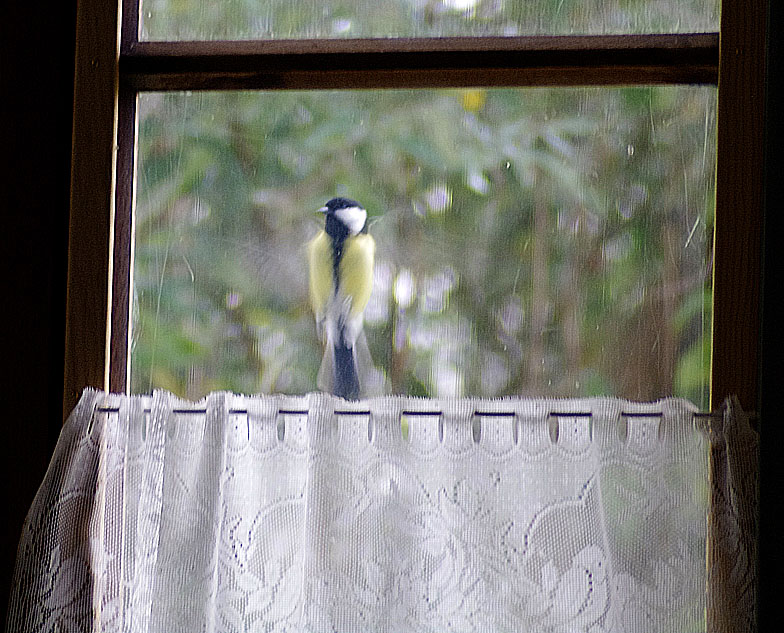
Outside our bedroom window hangs a bird feeder stocked with sunflower seeds, along with a fat-ball on a wire. These are visited by a constant stream of blue tits and great tits which have become adept at extracting the seeds. Yesterday the supply ran dangerously low, so we received a deputation - three great tits and a blue tit perched on the window bars, the largest of the great tits rapping on the glass with his beak. Bagger the tom cat flung himself at the window with a great thump, much to the birds' amusement. They simply retreated a little into the sprawling branches of the buddleia while we retrieved the feeder, refilled it and hung it up again. Then straight back they came. Tim has now made secondary double glazing panels in a thick plastic film, to protect the glass from the cat, and vice versa.

Cats watching birds

Bird watching cat

We have seen other species - chaffinches, robin and dunnock picking up "crumbs" from the ground; nuthatch and great spotted woodpecker briefly in the pine tree - but the tits are always present. Behind the laiterie we installed a fat block filled with dried insects, from Gamm Vert, and this lasted no time at all! Tim is now making his own fat blocks, using the Gamm Vert packet as a mould.
Hello.... is there anybody in there?
  

I said HELLO! Rat-a-tat-tat!!!


Look.... no wings!!


Sunday, 21 November 2010

Cranes and Panthers

So many cranes are now leaving the Lac du Der to the north of us that some had to come our way eventually. We came out of the house late yesterday morning to see a group of 54/52 heading south over the hill and "grue"ing heartily. I flagged this to grus-grus.com as they have no records for Indre et Loire this year. There are always a few, but not 40,000 at a time (what a noise that must have been)!

54 Cranes [Grus grus]
52 Cranes... where did the other two vanish to so quickly?


We were on our way to the Huilerie Lepine at Aveilles en Châtellerault, where the family business of walnut oil extraction was celebrating its 200th anniversary with an open day and Marché Gourmand. Instead of our usual route via Barrou and Lésigny, we went through La Guerche and Mairé, then through some very Brecklandish acid heathland / mixed woodland obviously maintained for hunting. The woodland is lined with deer fencing and there are numerous open rides. For several metres to either side of the road, an open stretch had been freshly ploughed - by humans as a fire break - whereas the verges had also been freshly ploughed - by boars, or possibly by deer. This looks like an excellent wildlife area, if not right at this moment! In the plough area, Tim spotted and photographed a fine array of what appeared to be Panther Cap mushrooms Amanita pantherina.... poisonous, almost as deadly as the Death Cap Amanita phalloides but much more striking... like a dark brown Fly Agaric Amanita muscaria.


Further on we came to La Chêne Rond, a major hunting lodge where dozens of hunters were standing along the edge of the road, shotguns broken, waiting for something to happen. Probably lunch.
When we came home Tim consulted the oracles and determined the mushrooms to have been The Blusher, amanita rubescens, which is good to eat. A bit too close for comfort to the poisonous kind for me!
The Blusher [Amanita rubescens]

Monday, 15 November 2010

One last butterfly on the wing

Still mild and moist and plenty of insects about. RonRon the nosy cat poked an ichneumon fly and got stung [they use the short ovipositor in defence], to her great indignation. A very small mayfly rested on the door of the laiterie, building up its strength for a mad short life. A red admiral was searching along the edge of the millstream in the sun - one last forage before hibernation.

Sunday, 7 November 2010

Le Petit Peuple de l'herbe

In the vast barn of the Prieure at Le Louroux yesterday, we found a fantastic exhibition of photographs taken of the insects on and around the Etang by David Greyo. This exhibition was presented in conjunction with the Conseil Général d’Indre-et-Loire for just the two days of the Fête de la pêche. The superb pictures provided clear examples for educational panels describing the different insect groups - ideal for an entomological novice like me. There was also a slideshow of shots including the grebes, terns, ducks and owls that make the Etang such a valuable wildlife area. An absolutely unmissable achievement - and all for two days? More about David Greyo and "Le Petit Peuple de l'herbe" can be found on his Blog

Friday, 5 November 2010

Autumn leaves

Raking the leaves is a philosophical occupation. The town has the latest technology as we saw today - a Stihl leafblower/sucker/broyeur. With one of these you can reduce a pile of leaves to a handful of instant leafmould, at the cost of the earth's precious resources. We have a rake (Dutch, plastic) and Big Hans (Bettawear, also plastic) and a couple of pop-up bags. You rake the leaves into piles, put on Big Hands and hoist the piles into the bags. The leaves are going in the traditional small chickenwire enclosure to become leafmould eventually, or alternatively to blow all over the field - we shall have to see! Today's rakings half-filled the enclosure, and are less than a tenth of what's on our handsome Small-Leaved Lime (Tilleul). There are both Large- and Small-leaved Limes in this area as we noticed today in Chambon.
While raking the leaves, you can think of all sorts of things. How many crows are there in that big roost up the valley? As night fell, the numbers sounded positively Hitchcockian. Was that our resident Stone Curlews calling, or a migrant? Will the bats come out for me, as they did for Tim last night? How can I stop myself singing 'Les Feuilles Mortes"?

Thursday, 4 November 2010

Late butterfly

Today was mild and humid as it has been all week. Insects are making good use of the ivy flowers on the bridge, including a Small White butterfly pieris rapae, la pieride de la rave.

Today we went to the Mairie to snitch on the muskrats. They didn't seem to have heard of the new decree there, but we now know that our neighbour Eric Decharte is an authorised trapper and we can contact him to get them 'rehomed' (ahem).