Aigronne Valley Wildlife pages

Tuesday, 22 November 2011

21/11/2001 - A movement of Cranes

We had three successive flights of Common Crane [Grus grus] Grue cendrée name over yesterday. Plus another two at least that we heard but didn't see. It is the latest we've seen them [it is after all almost December!!] and this is an entry just to put the fact on record.
[And to allow me to put some new pictures up....]


Stacking cranes.
This was the first flight of nine.

Six of Nine

Nine of Nine

Stacked - ready to glide

A thin ribbon of twenty cranes.... the second flight.

The third flight [14 individuals]....
the best shot of this bunch..
the autofocus on the camera was having great difficulty staying in touch!!

But the weather is very strange at the moment... the weather hit a balmy 19.6 Centigrade yesterday too! On Sunday we saw butterflies, Clouded Yellow [Colias crocea] le Souci being quite notable with its egg-yolk yellow colouring... and the Ivy [Hedera helix] Lierre is still alive with late feeding insects. All these insects are really quite important... the bats are still around!!

In the potager we are getting sprouts, still, from our "Tender-stem" brocolli. We've had a late crop into November before, but these are still producing a two servings worth a week in the fourth week of November!
There are still numerous wild flowers around.... most obvious are the Nettle-leaved Bellflower [Campanula trachelium] Campanule Galantelée and also Knapweeds, Scabious and Meadow Clary [Salvia pratensis] Sauge des Prés. But it also means that the trees I need to work on this winter are not yet dormant... oops! But, still, I've plenty to keep me going on the bricolage [D.I.Y.] side

Saturday, 19 November 2011

Get Orfff moy Laand!

Tim was peacefully looking out of the window this morning when he saw two crows escorting a large sparrowhawk off the premises. A very large sparrowhawk. Bigger, in fact, than the crows. In fact, it was a goshawk (accipiter gentilis) [autour des palombes]. We thought we'd seen one before, but weren't sure, although they are believed to nest in our commune. The English name derives from the anglo-saxon for "goosehawk", and the French name means "around the woodpigeons" - both these names give an impression of the size of prey the goshawk is capable of taking out. For this reason, the goshawk was popular in falconry. Here's a lovely picture from the BBC's Nature website.


In Britain, the goshawk was blamed for the death of game birds and, between the gamekeepers and the egg-collectors, became extinct in the 19th century. Escaped falconry birds and others from continental Europe have re-established a small population. They are still persecuted by the small number of egg-collecting criminal monsters.
In rural France, goshawks were treated as vermin (nuisibles) for their taste for creatures that humans like to eat, both wild and tame - "espèces gibier ou de basse cour". They have been protected since 1976, and their numbers are believed to be rising. This area has a great deal of their preferred open woodland habitat, and they have an excellent choice of prey - squirrels, rabbits, hares, voles, pheasants, partridges, pigeons, crows, starlings, thrushes.... but they are by no means common and it's lovely to know they are around. I love the expression la basse cour for the small domestic creatures such as fowl and rabbits that were so often to be the domain of the farmer's wife and children.

Thursday, 17 November 2011

Electric Fishing at La Celle-Guénand

We read with interest in La Nouvelle République of 16th November of an exercise to measure water quality on the Rémillon just north of its junction with the Aigronne, about 2.5 km upstream of us. This is a further part of the first tranche of the planned works launched by the Community of Communes of Southern Touraine earlier this year in the restoration of the watercourses comprising the Claise basin. What follows is my best attempt at a translation of the article. I claim no responsibility for the science!

An electric fishing exercise took place at the end of October at La Gachère, in La Celle-Guénand with the aim of getting to know the fish population of these watercourses but also to judge the effect of the works on the fish.

Copyright La Nouvelle Republique
The principle is as follows: a generator produces a continuous rectified current of between 300 and 600 volts (400 in this case). The negative pole is placed in the water at a fixed spot; the positive pole is connected to an insulating handle with a metal ring on the end from which the current flows. Once the positive pole is lowered into the water, an electric field is created and the fish swim at first towards the source of the current. This is called "forced swimming". Swimming directly up to the researchers, they are easily caught in a landing net for they are semi-conscious. They quickly recover and do not take any lasting harm.
The species of the specimens captured is determined and they are then weighed, measured and released undamaged. Each species of fish is characteristic of a type of environment. For example, brown trout (Salmo trutta fario, truite fario) prefer cool, swift-flowing and well-oxygenated waters, whereas freshwater bream (Abramis brama, brème) prefer slower, warmer flows. The objective is to check whether a watercourse described as "salmonicole" (rapid, cool and oxygenated water) is degraded or not by studying its fish population. If the fishing exercise reveals a large number of fish characteristic of slow warm waters, it can be ascertained that the watercourse is very degraded.
The results of late October's fishing exercises in the Rémillon at La Celle-Guénand shows a quite well preserved site with the presence of brown trout and species characteristic of salmonicole watercourses:
  • chabot, (Cottus gobio), [Miller's Thumb or Bullhead or Sculpin]
  • lamproie de planer (Lampetra planeri) [Brook Lamphrey]
  • loche franche (Barbatula barbatula) [Stone Loach]
At the Sauvaget site, at Bossay sur Claise, the location is very silty. Only one trout and some sticklebacks (Pungitius spp, épinochettes) show that the watercourse is very degraded in this sector but nevertheless retains the capacity to support trout.

Wednesday, 16 November 2011

More Wood Blewits

This is the most accurate picture so far.

A new photo, taken today after Pauline and I had been processing the lime leaves with the mower. Needless to say, these have all now been picked... best harvest we've had from around the lime.

Wood Blew its top?

Wood Blewits [Lepista nuda] Pied Bleu. We are fortunate enough to have these mushrooms growing under our lime tree. The French guide we use gives it two chefs hats... but says that the flavour isn't agreable to all [tastes like a mushroom to me.. but I can't taste goat in a chevre cheese either]. Unless we have Blewits [L. saeva] Pied Violet... three chefs hats?

My original guide... "Collins Guide to Mushrooms and Toadstools" [Morten Lange & F.Bayard Hora, 1963] lists them under the scientific name Tricholoma... T. nudum for the Wood Blewit and T. saevum for the Blewit and list them as "edible and good".
The French Guide... "Champignons - Reconnaitre, Cueillir, Cuisiner" [Pyrenees Magazine Thematique,  Milan Presse, 2007]  also gives T. nuda and Rhodopaxillus nudus for the Pied Bleu and just Rhodopaxillus saevus for the Pied Violet.
Paul Sterry's book "Mushrooms of Britain and Europe" [New Holland, 2001] uses the Lepista naming.

The caps of ours are a pale buff colour with lilac gills that are fused to a lilac/silver striated stem. This follows the illustration in my original guide for "Blewits"... but in the other two, more recent ones is closer to the "Wood Blewits" as is the fact that the stem is quite slim. I prefer to use photographic guides for mushroom identification, provided that the pictures are good.

Roger Philips "Mushrooms and other fungi of Great Britain & Europe" [Pan Books, 1981] is very good because he uses photographs of a number of specimens, including cut sections, but it is not pocket sized so can only be used at home! [You can also visit Roger's Mushrooms [his website with a lot more photos and extra information]

A lot of Paul Sterry's pictures seem over exposed, or under exposed, for specimens I know... and this is not good for other users. However, it could be down to the production of the book.[#]
I am not set up yet to look at the spore prints... but if they were pale pink and prickly that would have confirmed the identification of Lepista [Tricholoma] sp.
The stipe [stalk] is described in Collins as solid, although all the specimens that I've found have had a hollow centre, and the other guides don't mention the structure!
The fungi here and on our allotment in Leeds most closely resemble the Pied Bleu picture in the French guide... so I regard them as Wood Blewits [The allotment, in a former quarry, was long established, open land, heavily renovated in the 50's to 'tidy up' after the 2nd WW's "Grow for Britain" use. Our Wood Blewits there probably came in on some horse manure.]

These are my pictures:

They weren't this purple... the strong sunlight seems to have added a deeper purple cast to this picture.
[I'll have a go with Photoshop and see if I can get the colour better and replace it.]
These are the real colour...
The gills look as though the are seperate from the stalk... but aren't.


But both the Blewits are edible... and good... so that's what happened to them and how I used them is here on "De la Bonne Bouffe".

This is a better view of the caps, showing a better colour [taken indoors just before slicing].


[#] I've got the English and French versions of quite a few of my favourite guides now and the difference in colour of the pictures is quite marked in some cases!!

Tuesday, 15 November 2011

We're late, we're late for a very important date!

Or....

1st Crane "Where are all the others?"
2nd Crane "Told you we shouldn't have stopped for coffee!"

1st Crane "We didn't stop long."

2nd Crane "Yes, but if you'd had a double espresso like me, you'd be all fired up to fly faster! Instead, you had to have a grand café créme...."

At 4:15 pm a pair,.... yes, just a pair, of Common cranes [grus grus] flew over our house.
There were no others to be seen.... and we didn't hear any either.

But they were desperately trying to form a V!!

Sunday, 13 November 2011

Improving the Aigronne

Just recently, a big poster appeared by the Aigronne bridge, advertising aménagements du lit (improvements to the riverbed).
Aménagements du lit
Then a succession of dumper trucks began clattering to and fro past the house, delivering their contributions to a series of piles of white stone, mainly small but including some very big ones. At peak there were four different trucks passing at approximately quarter-hourly intervals. Then a big digger arrived and started nibbling away at the stones, depositing it carefully on the river bed between Gatault downstream of us and Le Moulin de Chevarnay upstream.
We had learned of the plan to improve the flow of the rivers and streams that make up the Claise basin at the Fête de la Chasse at Preuilly sur Creuse, but we hadn't appreciated that it was going to happen so soon. As Yohann Sionneau, the river technician, explained to us, many of the river banks in our area are effectively canalised in places, the numerous poplar trees at even spacings with every trace of cover for small wildlife scrupulously removed. The flow is too smooth and uniform between these pared-down banks, reducing thediversity of habitat. In places the bed has become too wide, so during periods of reduced flow, particularly in summer, the water becomes very shallow, reducing the oxygen levels. There is also too much silt, denying the fish access to the gravel beds where they spawn. All these factors diminish the biodiversity of the Aigronne. The project was financed by the water authority for the Loire and Brittany; the prefecture of Region Centre; and the community of communes of Touraine du Sud.

Using the stones, shingle banks and rocky outcrops have been created, so that the flow rate and depth of water are more varied. Increased turbulence allows the water to pick up more oxygen. When water levels are lower, the shingle banks reduce the width of the channel, so that such water that does flow is deeper. Thus the river bed is improved for wildlife, especially aquatic species such as - er - trout. Oh what a giveaway.
Destined for the riverbed
The work was done by a large digger and, whilst the large stones were dumped on the side, the main loads of smaller calcaire were dumped directly into the river. The digger then collected a bucket load and took it to where it was to be used.


This did make the river very cloudy to begin with as the powdered calcaire was washed out... but the river is now nice and clean again. We'll put up more shots of these bits over the seasons.


Thursday, 10 November 2011

I bet you can't do this!

Every autumn, flocks of lapwings (vanellus vanellus) vanneau huppé appear on the newly-ploughed fields up and down the Aigronne, taking flight at the least alarm and keeping in contact with each other by means of their "peewit" calls. At the moment, there are usually a few starlings (sturnus vulgaris) étourneau sansonnet with them, and later in the year, golden plover.

Just a small part of a larger flock.
There are bigger flocks in France than in the UK because farming methods over here are more favourable to their breeding cycle. Just north of Amiens we stopped and took pictures of a flock of over a thousand... it was an amazing sight!

Just part of the huge flock seen in October 2005... too big to capture in one shot!!

They are always worth a few pictures on a sunny day, with their white underparts flashing as they swirl aroud over their chosen feeding spot. This year Tim's photos caught one bird in the middle of a barrel roll, flying upside down....

Hey guys! Can you do this?

Wednesday, 9 November 2011

The teasers were...

As guessed, Wotisit one was a plant.. or what was left of it. An old Ivy [Hedera sp.] trunk and here it is...

You just have to ask...
Is the wall holding the ivy up?
or...
Is the ivy holding up the wall?

Number two was a section of a very small, but pretty snail [so close Susan... 'twas a mollusc] and isn't it pretty?....

In a whorl of its own! [Only 8mm across!]

Number three was the abdomen of a fabulous "garden"  or Orb Web spider Araneus diadematus

This is the 'view' of the back of the abdomen.
And this is it from the front!
I hope that the arachniphobes out there have picked themselves up!!

Wotisit Four was the thorax, as Susan guessed, the 'giant' hoverfly Melissa crabroformis

I love the "tribal mask" that the pattern on the thorax makes!

Thursday, 27 October 2011

A teaser for the Weekend

Early September was our last posting.... and much has happened.
We've been a bit too busy to put much up lately... despite being assured that Winter is here by the return of the Dabchick and the Robins... and getting in the harvest and processing tomatoes as fast as we can because of the frosts.... nursing colds.... watching a possible juvenile Goshawk  up on the ridge opposite [but it never getting close enough to make a positive identification]...so we thought we'd better keep our readers entertained.
So here is a picture quiz!
What are these four?


Wotisit1


Wotisit2


Wotisit3


Wotisit4


This is coming up with the irritating "lightbox" effect... but I will leave it like that as it works quite well in this instance.... just remember to click on the white X in the top right hand corner to get back to the blog entry.

We will give you the answers next week.

Hopefully, the internet cable will be installed through to the house from the office by then... and it will mean we will be more able to write on the fly and posts will become more frequent!!

Friday, 9 September 2011

Hiboux for Les Hiboux

Yesterday we were awoken by urgent pukpukpucking from the resident moorhens swimming in the millstream outside our bedroom window. The reason for such an alarm? Perched on a post overlooking the stream was a long-eared owl asio otus (hibou moyen-duc). The owl's gaze was directed into the clump of flag iris where the moorhens live, but when it heard us at the window, it turned that thousand mile stare on us....

Hoo...you lookin' at??! Eh!!?


It stayed several minutes perched on the post in the drizzle, being clucked at by the moorhens and buzzed by the kingfisher#, before it took off and flew downstream. Another moorhen then took up the alarm, suggesting that it only flew a little way, to the next moorhen territory.

Hey you! Yes, you in the blue smoking jacket!!
Hi! Come here often? Don't mind me... just doin' a spot of fishin.
You're not a Brown Fish Owl are you?
 Appropriate that an owl should visit us on the same day as two members of the Leeds 2CV club (Les Hiboux)!

# Missed a super shot though.... couldn't get to the camera in time.... the kingfisher came back to the perch, landed, immediately took off and hovered in front of the owl... and then shot back under the bridge just as I reached the camera!

Tuesday, 6 September 2011

A swarm of bee-eaters

Many times in the past weeks we have heard the unmistakeable "woorple-woorple" call of European bee-eaters (guépiers de europe, merops apiaster) here at la Forge. Morning and evening, numbers of these busy birds have taken to flying up and down the banks of the Aigronne. Last year we saw them further downstream towards the village, feeding over a field of lucerne. This year a lucerne crop is flowering just upstream of us, and we think they are roosting in trees just beside the weir that diverts water from the Aigronne into our millstream. In one photo, Tim counted 94 bee-eaters, and that wasn't the entire flock! Bee-eaters nest communally in holes in sandy cliffs (e.g. river banks). Presumably they nested somewhere not too far away, but as to where, we have no idea.
Birds on a wire [Bezuard in the background]
And off the wire


Last night [5th Sept] they came in to roost and there was a great sunset light to show off their spectacular colours.
They gave a ten minute show before retiring into the Poplars. At 7:30am they were still there discussing when to get up... after all, on a coldish morning there is no point in flying around after nothing! Wait until the big insects get going...

Caught it! [both me and the bee-eater!]

They fly fast... but don't leave vapour trails.

The bill is often raised like this... as if they sight along it?

They can be seen in an 'arrow' flight shape quite often... as here!

Tuesday, 30 August 2011

A jynx in the potager

On Saturday morning Tim saw an odd-looking woodpecker perching on one of the posts demarcating our vegetable garden. Brown, with a dark stripe down its back, it kept flying down to the ground to pick up the ants disturbed by our potato harvesting activities. A wryneck!

Yes it is here.... probably easier to spot if you click on the photo to enlarge it!


The English name, and the scientific name jynx torquilla come from its ability to twist its head around to fix potential attackers with a baleful stare. Its French name Torcol fourmilier indicates its diet which is almost exclusively ants. This woodpecker doesn't use its tail to help climb trees, and doesn't make nest holes in trees, preferring to take on existing holes. It is about the size and colour of a young starling, and easy to overlook. The only one we have seen previously was in Majorca, and we only saw that because a lot of birders were watching it already! According to Les Oiseaux de la Claise Tourangelle, the wryneck possibly nests in Le Grand Pressigny.


It is in the same position here but facing the camera.... great camoflague for a ground feeder!!


This is a back view showing the stripes to good effect. Now look back at the first picture....

The purple heron (ardea purpurea, héron purpré) that visited the ditch in the field next door later in the day was just the icing on the cake. It skulked its way along the bottom of the ditch, occasionally lifting its head to look our way to show us the lovely russet markings on its neck. No good photo, alas... but Tim tried some digiphotography using a small compact camera hand-held against the eyepiece of the 'scope. A case of "patting your head and rubbing your stomach" co-ordination [or lack of... thus "dodgyphotography was born!]


It is standing, body to the right... neck up to the left and looking towards the camera. The dark shape to the left of the head is nothing to do with the bird!

Tuesday, 16 August 2011

Kingfishers return

When we first saw the millstream, it was clear as crystal and full of fish. We could see trout moving through the water, and Tim saw native crayfish scooting* around. Kingfishers (Acedo atthis, martin pêcheur), flew to and fro, on one occasion taking a detour around the barn before going back to the stream.
Then suddenly, a couple of years ago, the water became cloudy. The waterweed was swamped by clinging grey mud. No more fish, no more crayfish. And no more Kingfishers. According to the River Technician, Yohann Sionneau, a local dairy farm was to blame, and judging by the muck they spread over the road from constant building work, that's very probable.

But since Yohann started work, the millstream has gradually cleared. There's still mud on the bottom, as can be seen if you chuck a pebble in, but the native weed and the fish are coming back. And this month, kingfishers too! The piercing whistle announces the passage of a blue bullet. When defrosting the freezer, Tim took some icefloes to the bridge for disposal (perfectly clean water, just a bit cold). As he dropped the largest over the parapet, he nearly brained a kingfisher flying underneath. This bird was followed by two more - they must have bred close by.

Yesterday we saw a kingfisher perching in the cherry suckers lining the bank outside our window. As usual, no camera to hand. As Tim tiptoed downstairs to get his camera, I watched it dive into the water for a small fish and hurtle back upstream out of sight. So - no pictures then.

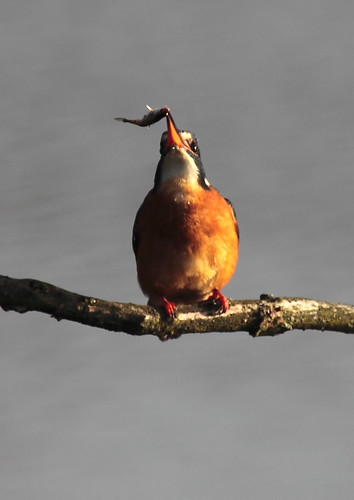
Fortunately Tim's brother Nick is an excellent wildlife photographer and has some stunning kingfisher pictures on his Flickr site... like this one!


Kingfisher (female) 

*A native crayfish, once, crawling along the stony bed of the ford!

Wednesday, 18 May 2011

The biggest Daddy Longlegs in France

When I went into the bedroom yesterday afternoon, I was stopped in my tracks by an enormous leggy insect on the window (outside, I'm rather glad to say). Tim was busy elsewhere so I went and fetched my new camera, which I've just dropped on the floor as I've been told that's the way to treat them. The manual is (a) massive and (b) on the computer so I did a bit of experimenting and got the macro feature to work after a few dud shots. It was the biggest cranefly (tipule) I'd ever seen, and we identified it from the books as a female tipula maxima. It's rather a fine animal, even if those legs make me shiver.

Wednesday, 13 April 2011

Not exactly a bowling green

Our front lawn, such as it was, now looks like a scale model of a battlefield after an artillery bombardment. Meandering trails of tufts of moss and grass are punctuated by shallow shell-craters. This happened last night or early this morning – a quick surgical strike without collateral damage.

There’s a long long trail a-winding….
Speculation – what caused it? Sangliers (wild boar) or deer would have caused considerably more damage. Besides, any animal of any size approaching on foot would have to come in via the bridge or the field across more grass, so why there, surrounded by fences and walls? Voles are too small to achieve such destruction in such a short time. We suspect either green woodpeckers or jays, after leatherjackets and other grubs.

Well it wasn’t exactly a bowling green anyway
The mass of feathers under the spruce is the result of another type of monster altogether - we have had woodpigeons nesting there, and the sparrowhawk (probably) got one. We found the corpse of an unfortunate squab, too, and no doubt the rest will die too. Forgive me if I don't grieve over the loss of a woodpigeon or two, after what they do to our brassicas and soft fruit.

Moths from underneath

There really should be a book about moths, aimed at those of us who see them in the comfort of our own living rooms, as they flutter against the window! The underside of the wings and body is often as subtle and delicately patterned as the upper side, though not as brightly coloured. Our latest such visitor was a female small emperor moth (pavonia pavonia, or sometimes saturnia pavonia, le petit paon de nuit). It's only the female that flies by night - she hangs about during the day, waiting for a male (day-flying) to turn up.

Female Emperor Moth

This female was particularly dim-witted, as she proceeded to deposit her eggs on the cold stone of the window mullion. She had a full range of food plants to choose from only metres away - alder and bramble to name but two, emperor moth caterpillars are not choosy. Unfortunately, the neatly glued array of eggs has already been pillaged, probably by a blue tit.

Here are the moth and the newly laid eggs.

 This isn't the only moth to have laid in an odd place.... Susan from Days on the Claise reported it here with reference to the Fox Moth [Macrothylacia rubi] le Bombyx de la ronce which seems to like doors! We've had one lay in almost the same position on one of our doors.

Thursday, 7 April 2011

Reddit, reddit... croak!!

This afternoon we were visited by a creature I had been longing to see... A Tree Frog [Hyla arborea] Rainette verte.
I was pretty certain we should have it around... but they are notoriously difficult to see... but this little* fellow wasn't!
It was just hopping across the grass at the back of the longére... and not very well camoflagued at that, either!
I had to take a photograph, so while Pauline ran to find my camera, I wet my hands on the dew-laden grass and picked it up. [Never handle a frog, toad or newt with dry hands... it is not appreciated... and in fact, is bad for them!]
I passed the frog to Pauline once she'd returned with the camera, and forgot to mention wetting her hands as I was rather over-excited!
The tree frog quickly left the hot hands and made for her shirt and then her hat... and posed quite well!
Trying to vanish on a shirt!

And then on a hat!

I then returned it to the moist vegetation and in this last picture you can see how well it can blend in!
But invisible at last in the nettles and goosegrass!!


*4 cms long! Look at the material of Pauline's shirt and the stitching on the hat... that will give you an idea of size!