Aigronne Valley Wildlife pages

Wednesday, 15 February 2012

White Ghosts in Winter

Recently we've been seeing ghosts!
Can you see what it is yet?

These have been in the form of great big white birds flying around... especially in the snow. They shouldn't be here, according to the books!

Looks magnificent in the sun...

What we are referring to are Great Egrets or Great White Egrets [Egretta alba or, more correctly #, Ardea alba alba] Grande Aigrette. These, like the Little Egret, now breeding in the UK, are an expansion success story... spreading rapidly in the last ten or so years and wintering further north each year... as I type, the Birdguides weekly report for 2nd to 9th of February is showing 27 birds reported.... of which eight were flocked together in one location in Somerset. How long before Great White Egrets are breeding in Britain?

We've tried here to give some idea of the rate of expansion... too fast for distribution maps in bird books to keep up with:


Years

Winter
[UK ]


Summer
[UK]


Winter
[Europe]


Summer [Europe]


1970s

Absent

Absent

Rare vagrant

Present
[non-breeding]

1980s

Absent
[Very rare vagrant]

Absent

Vagrant

Present [possibly breeding]

2000s

Rare vagrant
[Winter visitor]

Very rare vagrant

Present

Breeding species

Current

Every year [numbers
increasing]

Rare vagrant

Present

Breeding species
[numbers increasing]


This expanding population throughout Europe means that Great White Egrets are now seen more frequently. They prefer all kinds of wetland habitats - even farmland ditches can attract them [they certainly seem to here]. They hunting for fish, frogs, small mammals, and occasionally small reptiles and insects, spearing them with their long, sharp, spear-like bill, most of the time by standing still and allowing the prey to come within  striking distance of the spear, or to slowly stalk a victim before stabbing downwards.

The Great White Egret is one of Europe's most graceful looking birds due to its impressive size and pure white plumage. It could conceivably be mistaken for the equally white Little Egret but it is the size of a Grey Heron, and has a longer, often kinked, neck.

Little Egret [note the BLACK beak and yellow feet]
Another one of my brother's photographs!

It builds a bulky stick nest [often in colonies] in trees close to large lakes, or fishponds, with extensive areas of reed beds or other extensive wetlands.

Partially migratory and dispersive. Most European birds migrate to North Africa and the middle East (especially Israel) but they are also wintering in increasing numbers around the Adriatic and even in Holland

There are four subspecies in various parts of the world, which differ but little. Differences are bare part coloration in the breeding season and size; the largest A. a. modesta from Asia and Australasia some taxonomists consider a full species, the Eastern Great Egret (Ardea modesta).:

    Ardea alba alba (Europe)
    Ardea alba egretta (Americas)
    Ardea alba melanorhynchos (Africa)
    Ardea alba modesta (India, Southeast Asia, and Oceania)

The slaughter of egrets for their plumes lead to the formation in Didsbury (near Manchester) of the Society for the Protection of Birds in 1889, it received a royal warrant 15 years later; its lady members used farmed ostrich feathers instead. [This from the BTO website!]

This is a record of an interaction between three Grey Herons and the Great Egret pictured above:

Calmly waiting by the pond opposite Bezuard.
First, one Grey Heron arrives....
...cutting in quite close.
Then two more, one even closer which disturbs the egret a bit... but watch out, one landed behind it! [on the right]
The egret settles back down... But the third Grey Heron is just open his wings to make his attack run....
Heron coming in fast.... and the egret decides to seek somewhere more peaceful to dine!
And flies off down the valley towards the Moulin de Cheverny!

And the crow and Tim watched it all.
We've blogged about these magnificent birds before but they've been either in the Brenne or just a sighting here but this fellow has been around for over a week now... forced to flowing water by the frozen ground and étangs... nice for us, but I hope it gets more food now the 'melt's come.
Missed a lovely shot today [I had the binos... not the camera]... it came down our meadow, barely twenty feet from the house!!


Sources for this info: Collins "Bird Guide" 2000 [the 1st edition], Royal Society for the Protection of Birds, British Trust for Ornithology and Birdguides  websites and Wiki.

Other good source of information on the Egret is Go Birding.

# This is yet another re-classification*... I heartily wish they wouldn't!! 
*The Great Egret—unlike the typical egrets—does not belong to the genus Egretta but together with the great herons is today placed in Ardea. In the past, however, it was sometimes placed in Egretta or separated in a monotypic genus Casmerodius. [Wiki]

Thursday, 9 February 2012

Hare today

The hare was moving right to left...

Either the cold weather is making the creatures more venturesome, or it's just the snow revealing where they have passed. This morning we awoke to find an unmistakeable set of Hare (Lepus europaeus) lièvre tracks passing our front door.

Coming towards the camera
If you look closely at the first set of prints,
you can see the rear right paw mark clearly at the bottom of the hole.
A hare, travelling at some speed, crossed the bridge from the meadow, and accelerated around the end of the barn to the proto-hedge where it could cross the road. Each set of pawprints is a single splodge in the snow, with the two front feet in line at the back. The huge back feet pass the front feet as the hare bounds along, landing splayed out to either side.

Here, the hare's front feet are at the back and the orangy splodges, just above the front elbows, are the hind feet overtaking!

Hares are hunted for the pot throughout France and elsewhere. In our community of communes the hunting fraternity is performing a comptages(census) of hares because of concerns about the population, believed to be declining rapidly (more by habitat loss than from predation). The season for hares was 25 September to 4 December last year, so our hares can bounce in peace for the time being.

Here is that paw print again.

Wednesday, 8 February 2012

Black hats in the cherry tree

On Monday night, the temperature in our verger fell below -20°C, according to our weather station. It has not risen above freezing since Sunday. In this severe weather, we have seen several species using our bird feeders for the first time, including cirl bunting, collared dove and great spotted woodpecker.

Picture of Weather Station readings showing the lowest temperature yesterday!! [And what it got up to by 6.30.]

A male Blackcap (Sylvia Atricapila) Fauvette à Tête Noire has started helping himself to a couple of apples that we hung in our cherry tree. This handsome fellow, with his dove-grey cloak and smart black cap, is a member of the warbler familiy and a familiar summer visitor, but is resident in this part of France and in parts of southern England. We've seen winter Blackcaps (browncaps, if female/juvenile), but he was a first on the feeders.

Even apples turning to cider-mash are needed by this male Blackcap
The other, slightly more unusual, species is the Reed Bunting (Emberiza Schoeniclus) Bruant des Roseaux. In summer, the male Reed Bunting has a black head and bib, separated by a splendid cream moustache. In winter he retains the moustache, but his head becomes striped in shades of grey and his bib becomes more or less speckled with grey. He mainly feeds on the ground under the cherry tree among the dunnocks, blackbirds, song thrushes and moorhens, under a light rain of seeds kicked out of the feeders by the goldfinches.

A chilly looking male Reed Bunting


We only get the occasional greenfinch or chaffinch at the cherry tree feeders - our best customers there by far are the great tits, blue tits, house sparrows and goldfinches. Here they have a choice of peanuts, wild bird mixture, fat balls and home-made fat blocks. A feeder full of black sunflower seeds hangs from a young willow in the meadow. There the finches are the main customers, both at the feeder and accompanying several young pheasants on the ground.

The Field Feeders
From left: Female Greenfinch, Goldfinch on feeder and Greater-Spotted Woodpecker on his way to the fat balls.
The fat ball feeder is a coiled tube of fencing wire... cost = zero!
It allows fat balls to be used without the netting - now considered to be dangerous to birds' safety.


Despite today's unscheduled snow, there are signs of spring in the meadow. The robins are chasing each other around the cherry tree with their usual aggression. A pair of hares started boxing before disappearing into the blackthorns on the riverbank. Two female blackbirds are disputing rights of possession under the cherry tree. The male finches are starting to look splendid in their summer costumes. By providing food for the small birds we are setting out a dining table for the sparrowhawks, a no win situation I'm afraid. At least we can protect the birds from the cats to some extent. We have set up a chickenwire screen around the foot of the cherry tree to stop the cats rushing the ground-feeders there. Before the snow, Jerry would sit inside it, being teased by the wrens who kept just out of pouncing distance, but it's too cold there for him now.

Greater-Spotted Woodpecker on his way...

Sunday, 5 February 2012

Sad little bundle of feathers

Today we had a steady fall of fine snow which tailed off towards lunchtime, leaving the ground with a covering of about ten centimetres. Baron, our black tom cat, was beginning to get cabin fever and begged to be let out. Alas, he caught a Meadow Pipit (Anthus pratensis) Pipit Farlouse, which was foraging along the side of the hanger. Normally if you get to him quickly, he will release the bird unharmed and it will fly away, scolding. This time the little creature died in Tim's hand, although it had no sign of injury. On checking it over, there felt to be no flesh on its breast and it weighed only 15.1 grams.

Poor lttle scrap

According to Birds of the Western Palaearctic, the average weight for a healthy adult meadow pipit in autumn (and it has been autumnal up to very recently) is 18 grams.  Also listed are mortality weights of around 12 to15gms. The tip of the tail is quite worn, suggesting that this is an older bird. We think it was starving, exhausted and cold, and the shock of capture by a cat was the last straw. Until the cold spell started, there were plenty of insects around for it to eat. Its fate shows how quickly a small bird can run out of energy in cold weather.
Also worth noting is that this would have been [and technically still was] a new species for us here... we've seen them up on the 'tops' but never around here in the valley... so it had been driven to seek food in new areas.

The guilty party was sent to his basket, which is on the windowsill of our bedroom. Remarkably, he went!

Thursday, 2 February 2012

Visitors sniping at Winter's chill

An icy cold, misty grey morning yesterday to welcome in February... and a flash of white passed across the walnut tree trunk. I followed it with my eyes and saw a Hen Harrier [Circus cyaneus] Busard Saint-Martin.

Not the one I saw... my brother captured this today [3 Feb 12]


Recognisable, in the grey, only by its flight and the black tips of its wings as it coursed low over the fields towards the Moulin de Cheverny. A nice start to the day which brightened considerably as the sun burnt through the mist.

Song Thrush on the ivy this morning... the ivy berries [an important winter food source] are the black 'seeds'.
A Song Thrush gets chased off the ivy by a Blackbird by a rear assault [beak up backside]... "My ivy berries, you!" scolded the blackbird as it sat on them calling. Dunnocks, Robins and Wrens hurtling all over the place looking for insects, although the Robins have taken to feeding from the seed feeder here. Five pheasants clustered under the sunflower seed feeder in the field gleaning what the Greenfinches, hogging the field feeder, have scattered or wasted. Mr Creosote and his chums [Goldfinches] scattering seed from the seed feeder.... a Green Groundpecker* [Picus viridis] Pic vert working over the potager whilst it still could.
[*That should read Woodpecker... but for a bird that feeds mainly on grubs and ants from the ground perhaps Groundpecker would be better... it's like the Chocolated-headed Land Gull!]

What was that?...
I'm outa here!!

A trio of Willowchiffs [collective name for Willow Warbler/Chiffchaffs when you can't hear them singing] worked their way through the battered celery plants in the potager. All in all, awful lot of bird activity as they fought to keep up their food reserves in this cold, icy weather. But I had work to do... can't spend the whole day birdwatching.

A glance out of the window as a Blue Tit risks a direct flight of the one hundred metre open ground between the trees along the bank of the river Aigronne and the seed feeder here in the cherry tree... it flew low, to avoid the attention of predators... especially the local Sparrowhawk [which I saw burst like a rocket through  the top of the cherry a couple of days ago.] As he passed over the bief edge, I saw movement down by the water's edge... aha! The Water Rail; haven't seen him for a few days, thought I... but wait, that colouring seems wrong... look again.

A Snipe [Gallinago gallinago] Bécassine des marais was preening itself just opposite the kitchen window.
Then it went hunting for food. It looks for soft accessible organic soil, rich in food organisms just below surface. It also requires clumps or patches of vegetation/shrub as cover. Both of which it has aplenty along the bank of the bief.

The warming of the beak!
Warmer now... let's carry on...
It is not a common bird in France [Concise Birds of the Western Palearctic give the distribution in France as 300-350 breeding pairs; listed as decreasing - 2002] - we are towards the southern end of the range here, but it is believed to breed in the Brenne, where it would nest in a shallow scrape, concealed in short vegetation.

A-probing we shall go...

The winter distribution is as far away as the Nile valley and North Africa, but it is shown as a resident breeding species in the Loire valley.  So we are more likely to see them in the winter months. I thought I'd heard 'drumming' round here before, but had dismissed it as such... but pairing and display may well take place as they migrate to breeding grounds and we now know they feed around here in Winter.

Blending in well with the vegetation
He then went up on the bank to pose!

And he's there again now as I started to write this this morning, probing away at the mud along the edge... I wonder how often we've missed seeing them.

Monday, 30 January 2012

Winter is here

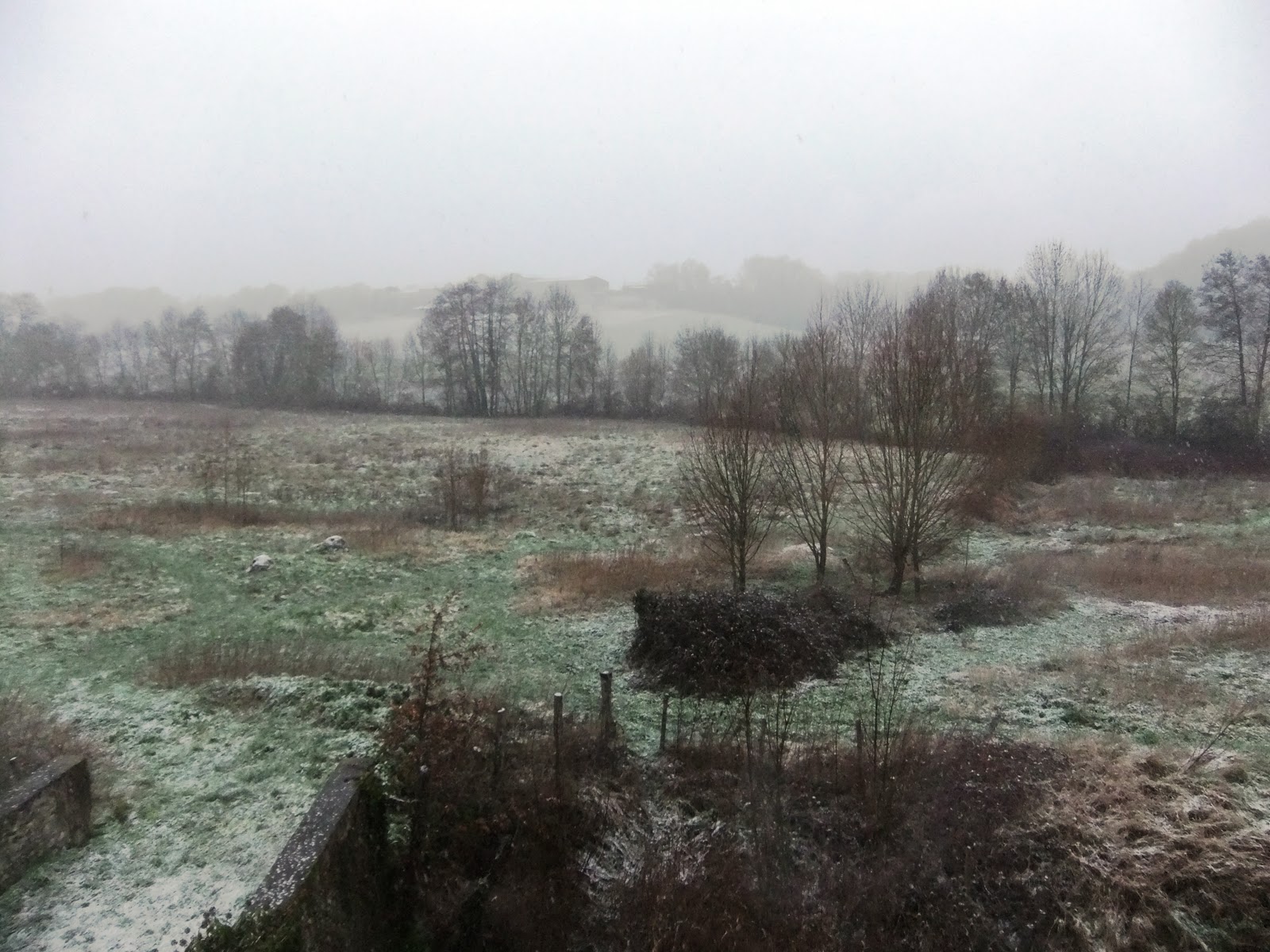
The meteo has been predicting snow for some while, with an amber alert for today - so much so that Meteociel's server was struggling to cope with the load. At about 2pm today it started to snow - very fine, wet snow (snizzle?), just a few flakes at a time at first. Although the temperature was a degree or two above freezing, the snow quickly began to settle, and by 5:30pm there was a light covering.

Grandmont behind a curtain of falling snow
Now (9:30pm) we have about 2cm, although the weather station registers zero precipitation. Either we've had less than 0.3mm of liquid, or the snow is just too fine for the rain gauge to register.

We also have a red-legged partridge  (alectoris rufa) perdrix rouge sitting on the front doorstep. It didn't fly away when Tim opened the door to offer it a handful of bird food. It just ambled a couple of metres away from the door and returned to pick up the grain. This rather odd photo was taken with flash switched off, so as not to disturb the bird's digestion. The background is our crushed limestone path, with blobs of snow.

Can I come in for a warm?


Thursday, 26 January 2012

Flocking Committees!

I was sitting in bed this morning with a mug of tea, watching the birds out of the window, when one of the flocks of Lapwings (or Green Plovers or Peewits if you are so inclined) muddled into view.
They seem to be birds of committee status... or a collections of politicians.

They were flying to the right... initially.... but then two decided to head back the way they'd come.
A few more followed them and then the rest of the flock...

First they flew to the right....
then they flew to the left...

No, wait.... at least three haven't followed... they are ploughing on steadily towards the right.
About turn the rest of the flock... they'd decided.

...then to the right. Again!

But...
they had not yet come to a firm decision...
one, then a further two, then a group started to fly back the way they'd come...
and again the rest of the flock followed...
everyone this time!

No... a breakaway group from the middle went right this time! Followed by....

...the rest!

This happened about four more times... before, quite suddenly, as they were all flying left, as one they turned and flew strongly off to the right and disappeared behind the trees.

A few minutes later a smaller group flew left to right without wavering at all.
Flocking committees!*


There's always a rebel in any committee!

*A committee is a dark corridor up which ideas are lured and quietly strangled!

Wednesday, 18 January 2012

VOLE WARS

Ten minutes ago I was watching the world out the bedroom window, as one does, and saw a splash just in front of me on the opposite side of the bief.
An underwater surge let me know where something was moving and a Water Vole [Arvicola amphibius] Campagnol amphibie or terrestre [I still lump them*] bobbed to the surface in the middle of the clump of Flag Iris. It then paddled fast towards our side.
A minute or two later it swam back across to the iris. At that point another vole leapt from about halfway up the opposite bank and swam furiously at the other, which dived immediately. There was then an underwater chase with 'our' vole eventually seeing the intruder off under the bridge. I was able to watch the whole event quite easily as the water has now returned to a nice clear state.
'Our' vole returned to the bank where we've seen it most often and sat for a couple of minutes looking fixedly toward the bridge, before turning and vanishing up the bank and into the vegetation.
Apart from the entertainment value, it is nice to know now that we have a 'population'.
No pictures... no camera... no time.

I've just glanced toward the bief and seen a vole scamper up the bank... wait, there are voles charging about again... someone is getting mighty upset... splashing through the shallows at the waters edge.

Went to fetch camera now I'm downstairs... cue for all to go quiet again!

And I've got things to do.... can't wait around all morning.

As it is much warmer today... and sunny.... it could be a pair, full of the joys of January?

* We probably get both Arvicola sapidus and A. terrestris in this area and they are pretty impossible to tell apart unless you've a skull to check the dentition against!

Wednesday, 28 December 2011

Back on the rails

The Water Rail's back
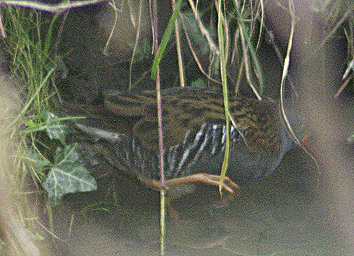
Yes, the Water Rails [Rallus aquaticus] Rale d'Eau are back... and we've got two of them this year. We spotted them for the first time yesterday... and we know we've got two because Pauline was looking at one whilst I was trying to get the camera to focus on another! In the end I moved round and managed to get some good shots of the one Pauline was watching.

Water rail's best side...
Water Rail bankside....

Also the Dabchick (or Little Grebe) [Tachybaptus ruficollis] Grebe castagneux is back... but the only photo I got of that shows an out of focus pair of frilly knickers!

You take your right foot out and shake it all about!

What we seem to be observing is birds that normally are recorded on the etangs appear to translocate to running water... not migrate as the local guide book, "Les Oiseaux du Bassin de la Claise Tourangelle", seems to indicate. So, because we have the bief, we get more moorhens, plus the water rails and the dabchick in winter.... where they a more assured of a good meal as it would be a very hard freeze indeed that stopped the bief running completely.
Our resident moorhens that Pauline blogged about the other week don't need to migrate... they are on running water all the year round..

Saturday, 17 December 2011

Joachim breezes past

'Twas a dark and stormy night on Thursday. The weather service Météociel was forecasting winds gusting up to 125 kph and at least five centimetres of rain in twelve hours, and the following day La Nouvelle République advised us that an official tempest, named Joachim, has just happened. The wind speed meter on our weather station is broken, but the audible wind noise was considerable. As for the rainfall meter, it indicated that we had 247.5 millimetres of rain in 24 hours. That's a quarter of a metre all but, and totally out of proportion. It looks like the wind was affecting it, so we don't know exactly how much we got. Sandaysoft confirms that strong wind is a known problem with our weather station, and points us to a forum entry discussing baffles that could make it a bit more accurate.

On Thursday afternoon we watched in some anxiety as the bief rose from its normal tinkling brook to a roaring stream the colour of milky tea. Tim went down in the night to check on the water level and to close a shutter that had come unhitched. The following morning the rain continued to fall and the water continued to rise. The muskrat and the moorhen coped well with the force of the flow, crossing bravely sideways from one side to the other and finding slack water where they could make good progress under the bank.

Our water meadow.... the strip of water from lower left to top right is one of the mown paths... and the pond the other side!


At the peak, the buildings were still a good metre above the water level, as the watermeadows along the valley did their job. A "route inondée" sign near the junction to Favier indicates that the bief had burst its banks there, but water only partially covered the road and we were never cut off from the village. The worst damage we took was to the stable door, which was in a bad state to begin with and just got torn open. Our neighbour Richard evacuated his sheep from their home on the edge of his étang, carrying them by the feet upside down (rigweltered, as they say in Yorkshire) and docile, from their little shack to his trailer. We don't know where Jerry the outdoor cat was during the storm, but he turned up unconcerned on Saturday morning!
Heavy rain will drive earthworms out of the ground, and we saw several bird species taking advantage of this along the edge of the floodwater - lapwings, blackheaded gulls, crows and herons among them. A male sparrowhawk came to sit in our cherry tree, turning obligingly through 180° so we could admire him properly and take photographs.

Looking from the longere to the 'dry' bridge...

...and the view the other way.
La Forge is on the left with Bezuard behind, Moulin de Favier is in the middle and Favier is the next toward the right.
The bief was coping well with the right angle bend at the moulin!!

On our way to the Christmas Market at La Celle Guénand, we passed numerous washes of gravel and mud and one minor landslip on the road where rainwater had streamed off the fields. At Le Moulin Neuf, a big old poplar had come down, leaving a great plate of earth and roots projecting over the Aigronne. The commune had been quick to cut off projecting branches and clear the lane, but the main electricity cable was still hanging to the ground where the tree had pulled it down. Fortunately the cable still appeared to be in one piece.

The Aigronne and its watermeadows at Gatault
[Click on the photo to view full size]

Saturday, 10 December 2011

Water chickens revisited

Two generations of moorhens on the millstream
Almost exactly a year ago we blogged about our resident moorhens [gallinula cloropus]. At the time we had not realised the two adults had a very young juvenile with them, probably the one we had seen as a fluffball in September. We nicknamed this youngster "yellownose" as it had not yet developed a frontal plate (the red bit) and the unadorned beak is yellow. Throughout the winter we observed Yellownose and / or its parents plodding cautiously up the bank of the millstream to the area beneath the feeders where they had learned there would be stray seeds and scraps of fat. As the adult characteristics began to develop, Yellownose grew into Pinknose and then a fully grown adult with a shiny red frontal plate, but still slightly browner than its parents. In April there was a series of fights over the territory between the bridge and the walnut tree. Pinknose won by two submissions and we assumed that it was a him when it started building a nest platform by carefully folding down the young leaves in the middle of the flag iris patch.

That shows you how little we knew about a bird we saw every day from our kitchen window. A second bird appeared, with a more prominent frontal plate. This bird always greets Pinknose by fanning out his tail - it was Pinknose that was the female. By May, Pinknose was sitting on the nest, almost completely hidden among the iris. 

Spot the moorhen

We saw the pair throughout the summer, less regularly since more cautious, with three fluffballs, and now they have a Yellownose and a Pinknose of their own. Once again, moorhens en famille are visiting our bird feeders. Every day and often at night we hear their clucking calls and panicked splashing.
Dad and Pinknose Junior

What big feet! Note the lack of a web

Youngster amid what remains of the iris
Which leads us to another odd thing - the local bird guide, Les oiseaux du bassin de la Claise tourangelle, shows both the gallinule poule-d'eau and the râle d'eau (water rail) as resident from mid-February to mid-December and absent the rest of the time. Where are they supposed to go over Christmas? It's nice to think of the moorhens of southern Touraine taking a mediterranean cruise to visit their cousins the Purple Gallinules in the s'Albufera reserve on the island of Majorca. In the far north (Siberia for instance), Moorhens do migrate to avoid a deep-frozen winter. Possibly, in our region, the ones that hold territories on the étangs will move to running water which will not freeze over in hard weather. We certainly see more pairs along the millstream at this time of year. Or possibly the authors of our local guide copied it from someone who had it from someone else that moorhens migrate...

Tuesday, 6 December 2011

Foxes we have known

The sight of a fox in the car headlights, dashing across the road near the road to Favier the other evening, brought back memories of past encounters with foxes. As we were city folks, most of these encounters have been with urban foxes, because this resourceful and adaptable species (renard) [vulpes vulpes] has found city life very much to its liking.
The first fox I remember was in the village of Lapworth, near Birmingham, where a young fox was being kept in a not particularly large cage. I recall it had been brought up from a cub by the publican's family, but was too wild to run free. I was only a kid myself then, and no doubt such treatment would be illegal now.
As I grew up in Birmingham, there were sounds at night that I recognised as the barking of foxes, and I saw one from my parents' bedroom window, fast asleep in the sun on the neighbours' coalshed roof. Presumably it thought it couldn't be seen there, and indeed it was pretty secure.
Fast forward to Leeds, and a house a hundred metres from a deep, scrub-covered railway cutting. More barking, more night-time glimpses of foxes passing under the streetlights. One night coming home from work after baby-sitting a software install, I was given a lift by a colleague who dropped me on the corner of the street. As I walked towards our house I noticed a traffic cone on the edge of the pavement. "Ruddy students" I thought (it was three a.m. and I was tired). When I came up to it, it looked up at me. It wasn't a traffic cone, but a fox, completely unafraid. "Hello, fox" I said, and crossed the road to our front gate. When I went up the steps, the fox was close behind me. When Tim opened the door, the fox went straight into the hall. It drank a saucer of milk, had its picture taken, and left.

Mine's a milk, please!

Ta!!


More recently still, foxes took up residence on the allotments on the opposite side of the railway line. The allotment holders, well some of the more excitable ones,  formed into two camps: pro-fox and anti-fox. The anti-fox camp pointed out that foxes have been known to kill cats and they carry some vile diseases such as toxocara canis (both true, and in France, even more so, with rabies and echinococcus tapeworm infections). The pro-fox camp returned that foxes kill rats and mice and slugs and snails (equally true). Tempers became frayed on both sides and some wild accusations began to fly. Meanwhile the foxes were in fox heaven, with people bringing them dogfood and lots of lovely greenhouses to play in, fleece to rip and plants to dig up. Not to mention gloves and shoes for the cubs to steal as toys and training aids. Despite the sound and fury, the foxes are still there. As for whose locker contained the size 8 purple patent leather stiletto-heeled court shoe, nobody's telling.

All the following photos are from one of our allotment friend's flickr site...
Phil's a very patient photographer... and tends to get up to the allotments before many people are around.

Trusting Fox
Trusting Fox by P.Pix

Three generations by P.Pix

3 Generations - The Old Girl
The old girl


3 Generations - Daughter
The Daughter


3 Generations - Tiny Tot  Fox
And one of her tiny tots!!

5 Pairs of Ears
Five pairs of ears by P.Pix.


Locked After Mating
Locked after mating! by P.Pix.  The male is the one looking a bit embarrassed.

And finally a nice seasonal wintery shot!!


Distracted Fox
Distracted Fox by P.Pix

There are a lot more there... click on one of the photos and take a trawl!
[To make the trawl easier... search on his site for Fox.]