


Showing posts with label birds. Show all posts
Showing posts with label birds. Show all posts
Thursday, 24 April 2014
Massacre on Migration - Chris Packham's video diaries
Parts 1 and 2 of Chris Packham's video diaries of his mission in Malta can be found here. For more information, visit Chris's website www.chrispackham.co.uk.
Thursday, 27 March 2014
The birds of Yzeures sur Creuse
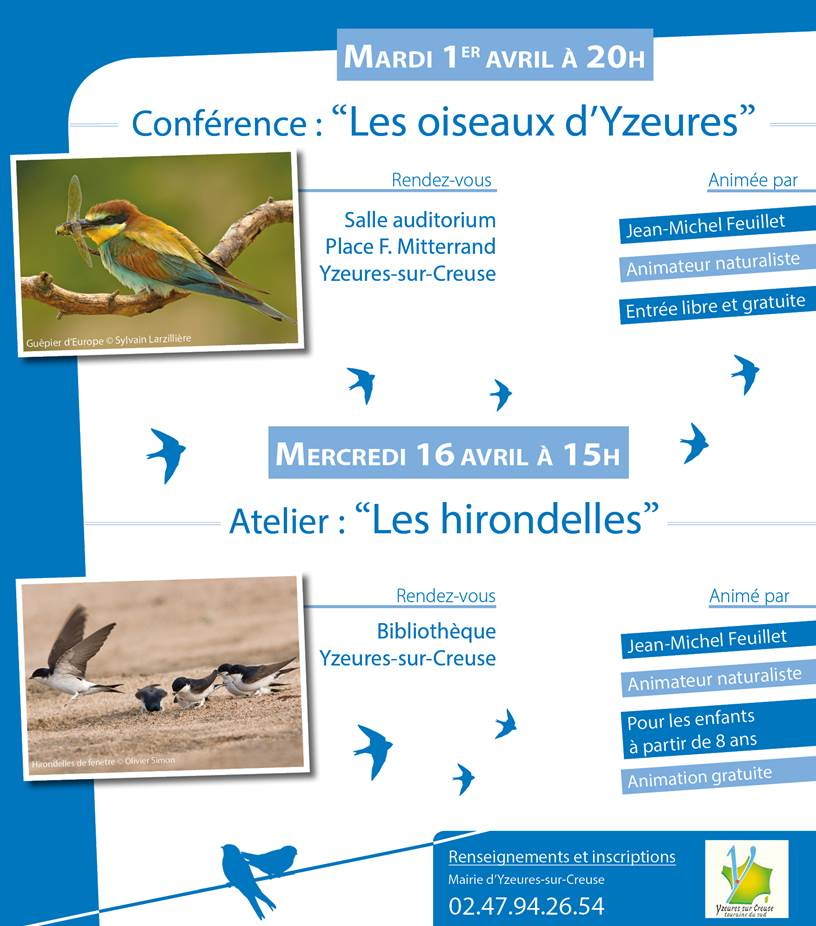
LPO Touraine invite you to two events in Yzeures sur Creuse! The first, on Tuesday 1st April at 8pm, is a talk on the Birds of Yzeures, by Jean-Michel Feuillet, a local naturalist and animateur. This event, intriguingly illustrated by a photograph of a bee-eater, is in the Salle Auditorium on Place François Mitterand, is free to all.
The second event, entitled Swallows is a workshop for youngsters from eight years upwards, and is also free. This is at 3pm on Wednesday 16th April in the Library at Yzeures. A splendid opportunity for your child to get covered in clay making a swallow nest! For more information and to inscribe, contact the Mairie on 02.47.94.36.54.
In France, what we know as house martins, sand martins and swifts are all varieties of hirondelle, the swallow itself being a hirondelle rustique. Hirondelle may be better translated as "hirundine", but that's a bit of a mouthful for most eight-year-olds, although on second thoughts many are perfectly au fait with the diplodocus!.
The second event, entitled Swallows is a workshop for youngsters from eight years upwards, and is also free. This is at 3pm on Wednesday 16th April in the Library at Yzeures. A splendid opportunity for your child to get covered in clay making a swallow nest! For more information and to inscribe, contact the Mairie on 02.47.94.36.54.
In France, what we know as house martins, sand martins and swifts are all varieties of hirondelle, the swallow itself being a hirondelle rustique. Hirondelle may be better translated as "hirundine", but that's a bit of a mouthful for most eight-year-olds, although on second thoughts many are perfectly au fait with the diplodocus!.
Wednesday, 22 January 2014
25 et 26 janvier 2014 : Grand comptage d'oiseaux du jardin
The RSPB's Big Garden Birdwatch is in its thirtieth year. During the weekend of 25th/26th January, spend an hour recording the birds that use your garden, and pass the results to the RSPB.
Meanwhile, in France...

The Ligue pour la Protection des Oiseaux (LPO), in conjunction with the National Natural History Museum of France, is running the same thing, on the same days, for the second year. Last year, Britain achieved nearly 600,000 observers, France just over 3,000 who recorded 160,000 birds. The numbers in France may seem small, but it is possible to obtain valuable scientific data nevertheless. For example, the LPO has issued a press release entitled "Unusual absence of birds frequenting our bird tables" pointing to a 30% reduction in numbers and attributing it to the poor spring of 2013 and the mild temperatures which mean that migratory species are staying further north than normal. This count will provide evidence to show whether those northerly species have started to arrive.
And last year was just the first year. The LPO's introduction to the snappily-titled "appointment in the gardens to count the birds there" is here.
All you have to do is
The birds have to be using your garden. That is, a buzzard flying overhead does not count. A sparrowhawk diving through in search of prey does count. Also, record the maximum number of birds of any particular species you see at any one time. You may think there are more than three bluetits around, but you can't be sure.
That fourth point is the fun bit. Full details of the registration and data entry procedures are here. It explains that oiseauxdesjardins is a national site (using the VisioNature database), but there are a number of regional or departmental sites with portals to the national site. If your garden is in one of these areas, you will be redirected to the local site to complete your observer's registration and enter your data. You can record more than one garden, but you only register as an observer once.
The registration procedure is:
The RSPB has made use of sophisticated technology such as a smartphone app to register bird sitings in real time, and a downloadable data set of last year's results. But unsophisticated old me, I don't have a smartphone or a recent enough version of Excel to handle the data set. The RSPB recently renamed its magazine from "Birds" to "Nature's Home". My response was "Eeeoouw". Are we in danger of getting a bit too family friendly?
Meanwhile, in France...

The Ligue pour la Protection des Oiseaux (LPO), in conjunction with the National Natural History Museum of France, is running the same thing, on the same days, for the second year. Last year, Britain achieved nearly 600,000 observers, France just over 3,000 who recorded 160,000 birds. The numbers in France may seem small, but it is possible to obtain valuable scientific data nevertheless. For example, the LPO has issued a press release entitled "Unusual absence of birds frequenting our bird tables" pointing to a 30% reduction in numbers and attributing it to the poor spring of 2013 and the mild temperatures which mean that migratory species are staying further north than normal. This count will provide evidence to show whether those northerly species have started to arrive.
And last year was just the first year. The LPO's introduction to the snappily-titled "appointment in the gardens to count the birds there" is here.
All you have to do is
- choose a day and one-hour time period that weekend
- choose a place - your private garden, workplace grounds, local public park or balcony
- count the birds you see. A downloadable sheet is provided for this purpose with pictures of the 52 commonest garden birds on it, though hawfinch might be a bit optimistic. This sheet also gives the French names for these birds, which you will need for entering the data. There are a number of sites which give bird names in English, French and their scientific form, such as this one. For those with Android, you can buy an app, apparently.
- submit the counts via the oiseauxdesjardins website here.
 |
| Crib sheet, page 1 |
The birds have to be using your garden. That is, a buzzard flying overhead does not count. A sparrowhawk diving through in search of prey does count. Also, record the maximum number of birds of any particular species you see at any one time. You may think there are more than three bluetits around, but you can't be sure.
That fourth point is the fun bit. Full details of the registration and data entry procedures are here. It explains that oiseauxdesjardins is a national site (using the VisioNature database), but there are a number of regional or departmental sites with portals to the national site. If your garden is in one of these areas, you will be redirected to the local site to complete your observer's registration and enter your data. You can record more than one garden, but you only register as an observer once.
The registration procedure is:
- Go to www.oiseauxdesjardins.fr
- Click on "j'aimerais participer" (green box at the top of the page)
- Select your département.
- If you have a local site, you are redirected there. In Indre et Loire this is www.faune-touraine.fr.. In future, you will always use this local site. .If redirected, once again Click on "j'aimerais participer".
- Fill in the registration form (name, address, e-mail address) and validate it. An e-mail will be sent to you with your password. When you receive this, you can sign on to the observatory and register a garden.
- Decide on a name for your garden.
- Click on Participer - Oiseaux des Jardins - Ajouter un Jardin.
- Select your département
- Select your commune.
- Locate your garden on the map by moving the red pointer.
- Enter the name of your garden.
- Click on Suivant.
- Fill in the Garden Description form then click on "enregistrer les données" to register the garden.
- Click on Participer - Oiseaux des Jardins - Transmettre les observations de mon jardin.
- Enter the day and time of your birdwatch session
- For each species of bird you have seen during this session that is on the principal list of garden birds, click on the bird, enter the count and press suivant.
- For any species not on the principal list, bring up the data entry form by clicking on one of the principal species, and select ajouter une espece. Click on the species, enter the count and press suivant.
The RSPB has made use of sophisticated technology such as a smartphone app to register bird sitings in real time, and a downloadable data set of last year's results. But unsophisticated old me, I don't have a smartphone or a recent enough version of Excel to handle the data set. The RSPB recently renamed its magazine from "Birds" to "Nature's Home". My response was "Eeeoouw". Are we in danger of getting a bit too family friendly?
Subscribe to:
Posts (Atom)


